Day Three Insights from the National Wild Turkey Symposium: Part One
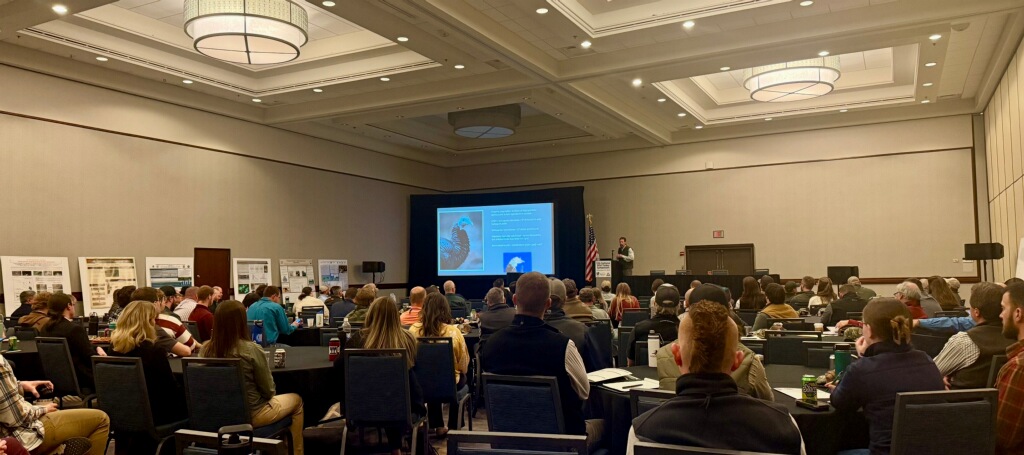
KANSAS CITY, Mo. — The final day of the 13th National Wild Turkey Symposium delivered a full slate of engaging presentations that are shaping how state agencies are managing wild turkeys. Attendees soaked up every insight.
The morning opened with a deep dive across four states, each presentation adding another piece to the puzzle of what’s driving turkey populations and how managers can use these insights to manage for healthy, robust populations.
Population Dynamics – A Regional Look Around the USA
The morning’s first presentation, delivered by Colter Chitwood, Ph.D., assistant professor of natural resource ecology and management at Oklahoma State University, shared insights from southeastern Oklahoma, in their effort to understand wild turkey declines in the region, determine the current population trajectory and identify which demographic factors had the greatest influence on the asymptotic population growth rate. Chitwood presented vital-rate estimates that painted a picture showing low annual survival, especially for second-year females, and mammalian predation was the leading cause of mortality. Reproductive output was low, with only 17% of incubated nests hatched, and not a single poult survived to independence.
Reina Tyl of the Pennsylvania Game Commission followed with an analysis of wild turkey population growth in northeastern South Dakota, where declining hunter success has raised concern about declining abundance. Researchers used detailed estimates of female survival and reproduction to build a population model that helps predict whether turkey numbers in the area are growing, stable or declining. They also ran tests within the model to see how changes in different factors, like poult survival or adult hen survival, would affect the overall population. This allowed them to identify which pieces of the life cycle have the biggest impact on whether the turkey population increases or decreases.
Next, Angela Holland, Ph.D., assistant Professor of wildlife ecology at the University of Delaware, presented updated spring survival estimates for wild turkeys in Delaware. Researchers monitored female turkeys from 2010 to 2012 and males from 2019 to 2021, providing one of the few datasets that compare demographic rates across sexes and time periods in the Mid-Atlantic. Predation was the leading cause of female mortality, while legal harvest accounted for the majority of male spring deaths. Adult male survival remained consistent across years, though juvenile male survival varied. Although overall survival rates suggested a generally stable population, Holland noted that the low adult female spring survival observed in 2010 was concerning, especially in light of a growing coyote population. She emphasized the need for updated demographic work to reassess trends and guide future management.
The final presentation in this session, delivered by Chad Argabright, student researcher at Louisiana State University, examined whether translocated turkeys behave differently from resident birds in east Texas. By comparing nesting rates and space use among extant females and two groups of translocated hens, those moved into landscapes with existing turkeys (TCP) and those released into areas without conspecifics (TCA), researchers detected clear differences.
TCA females exhibited the lowest nesting rates and used pre-laying ranges up to twice as large as other groups. Translocated hens also showed reduced overlap with historically used pre-laying areas, suggesting that familiarity with the landscape and presence of conspecifics both play roles in nesting behavior and success. These findings underscore that translocation outcomes can vary widely and highlight the importance of release-site conditions, particularly the presence of established turkey populations.
Human Dimensions and Hunting
The morning then transitioned into the human dimensions of wild turkey management, beginning with Patrick Wightman, Ph.D., assistant research scientist at the University of Georgia, who explored how hunting pressure influences male wild turkey movement and resource selection in hunted versus non-hunted populations. Researchers found that when hunting season began, male wild turkeys in the hunted area temporarily shrank the size of the places they used, cutting their home ranges by more than half and sticking to much smaller core areas. Even though their overall movement each day didn’t change much, these birds were more loyal to the same roosting spots. Turkeys in areas without hunting tended to stay closer to open spaces and roads, while turkeys in hunted areas shifted away from those spots until hunting pressure stopped.
Overall, the study shows that male turkeys do change their behavior to avoid perceived danger from hunting, but these adjustments don’t last long once the pressure is gone. His findings contribute to a growing understanding of how hunter activity shapes male behavior during the spring season.
Next, Zachary Steele, Ph.D., post doctoral scholar at Ohio State University, offered a review of current research on the human dimensions of wild turkey hunting, conducting a systematic literature review of 32 studies from 1985 to 2023 across 20 states in the United States, mostly in the Southeast. Researchers found that the typical wild turkey hunter is older than the average hunter and far more likely to be male. In his presentation, Steele suggests that expanding the way we study turkey hunters by using interviews, mixed methods and stronger research frameworks could give us a much better understanding of why new hunters may not be joining the sport, what motivates people to hunt and how hunter identity forms.
Finally, David Moscicki, Ph.D., turkey program coordinator for the Arkansas Game and Fish Commission, presented his research examining how gobbling activity varies geographically in relation to female nesting chronology, offering insights that may help refine the timing of season frameworks across regions.
Researchers collected gobbling chronology data using autonomous recording units and determined nesting chronology of 370 female Eastern wild turkeys monitored with GPS transmitters across three distinct ecoregions in North Carolina between 2020 and 2022. During this time, researchers recorded 63,456 gobbles and located 420 nests.
Researchers found that while gobbling activity changed from day to day and year to year within each region, the overall timing of gobbling didn’t differ much between regions. Nesting also began around the same time each year and across all areas studied, suggesting that day length rather than weather or elevation is the main factor that triggers hens to start incubating their nests.
They discovered two consistent time lags between peak gobbling and nesting activity, but gobbling didn’t follow a predictable pattern across all years. In some places and years, gobbling dropped once hens began incubating; in others, males kept gobbling at high levels during incubation. Because nesting timing was so consistent across regions within the same latitude, the researchers concluded that having uniform spring hunting season start dates across those areas makes sense.
After a packed series of presentations and lively Q&A sessions, attendees broke for lunch one step closer to wrapping up a landmark week of collaboration, discovery and commitment to the future of the wild turkey.
For a deeper look at the research shared from day two of the 13th National Wild Turkey Symposium and what’s to come throughout the week, explore the full list of published works.
When attendees returned from lunch, the symposium shifted gears, diving into emerging technologies, innovative monitoring tools and new approaches to estimating survival and abundance — research that is pushing wild turkey science beyond traditional field methods. In Part 2, we’ll break down research that could redefine how turkeys are studied and managed in the years ahead.
About the National Wild Turkey Federation
Since 1973, the National Wild Turkey Federation has invested over half a billion dollars into wildlife conservation and has positively impacted over 24 million acres of critical wildlife habitat. The NWTF has also invested over $10 million into wild turkey research to guide the management of the wild turkey population and to ensure sustainable populations into perpetuity. The organization continues to deliver its mission by working across boundaries on a landscape scale through its Four Shared Values: clean and abundant water, healthy forests and wildlife habitat, resilient communities and robust recreational opportunities. With the help of its dedicated members, partners and staff, the NWTF continues its work to provide Healthy Habitats and Healthy Harvests for future generations.