Ask Dr. Tom: Circle of Security
Dr. Tom opines on turkey behavior and formations.
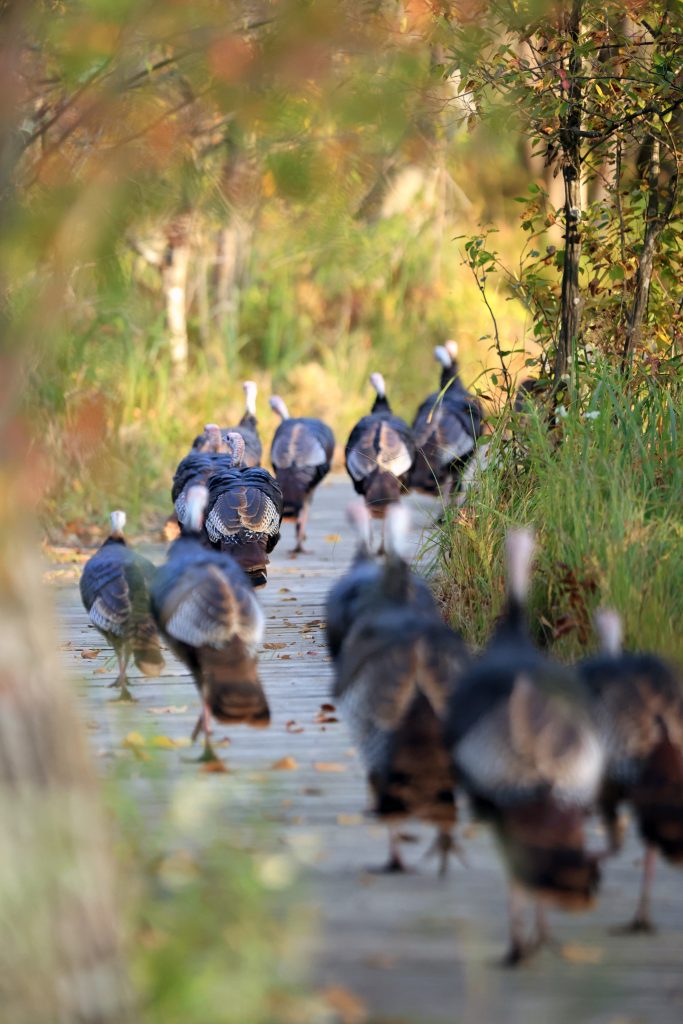
A couple years ago I watched a tom and three jakes enter this field. The tom strutted and a group of hens came out of the tree line. After a few minutes of mixing and chasing, one hen got the tom’s attention. As they began their ritual the other hens and jakes formed a circle facing away from the tom and hen as if on guard duty. Then they all mixed together again until the next hen was ready. They formed the circle again, this happened a few times until they were spooked from the field. Have you ever seen or heard of this before?
— Douglas Battoe, via email
Dr. Tom's Response
Thanks for sharing your hunting experience and that observation of strange behavior with us. The appearance of a “circle of security” around the dominant tom was likely happenstance rather than sentry duty. The birds not directly involved in the mating activity were avoiding approaching too close to the dominant gobbler but probably wanted to remain in a loosely connected flock. The jakes definitely did not want to infringe.
You may remember a YouTube video that circulated a couple of years ago. A flock of hens and young turkeys appeared to surround a domestic cat in a suburban neighborhood. They moved as a group across a road and a lawn staying alert, watching the reaction of the cat but not acting terribly threatened by it. I witnessed a similar response to a domestic cat several years ago in a hay field. Three hens and a dozen half-grown poults surrounded a cat, the hens purring loudly. They seemed to be more curious than threatened, but the hens were focused on the cat. That animal did not pose much danger to the adult birds and even the poults were large enough to be of little interest. The cat finally jumped past the flock onto a hay bale and lay there until the hens lost interest and moved away.
Reactions of young turkeys and even adults to noticing something new can be entertaining. Artist and naturalist Joe Hutto described one or two of these situations in his book Illumination in the Flatwoods. Hutto raised a small flock of imprinted wild turkey poults and took notes of their behavior. He described an encounter the poults had with an eastern diamondback rattler saying that they gathered around the snake acting “curious” but nervous and disturbed. The poults maintained a distance of 2 or 3 feet from the snake issuing alarm calls as it rattled. This lasted for a few minutes and when he, as their substitute hen moved away, they followed. The poults were interested in the snake and wary of it but not greatly alarmed. This was like the situations with domestic cats.
Hen and jake flocks often move through the woods in a straight line, one behind the other, when they are on a mission like going to a baited site. Otherwise, they move along in a wide group scratching and searching for food items. One or two hens are usually the leaders, and the larger group moves at their pace and in their direction. Groups of hens and poults feeding on insects in a field appear to move in a skirmish line with the hen on one end and the poults in a line adjacent to one side of her. As was the case with the cat video, mildly disturbed flocks may surround the cause of their disturbance such as a snake or that house cat. As they are feeding in a field situation in winter or spring before the breakup, they are scattered across the field keeping in touch by purring but allowing personal space between birds. When it comes to breeding, the dominant toms get some respect as jakes and subdominant gobblers give them space but stay close enough to form loose-fitting flocks.
Wild turkeys are fascinating birds. Their gregarious, social behavior and their interactions with other animals are a joy to watch. The more time a person spends watching wild turkeys, the more he or she realizes they are complex and can continue to surprise us with behaviors and circumstances we have not observed before.
Send your wild turkey questions, photos and videos to turkeycall@nwtf.net for Dr. Tom to answer.