Ask Dr. Tom: The Physics Behind Wild Turkey Force
Dr. Tom calculates the estimated strength of a fighting gobbler.
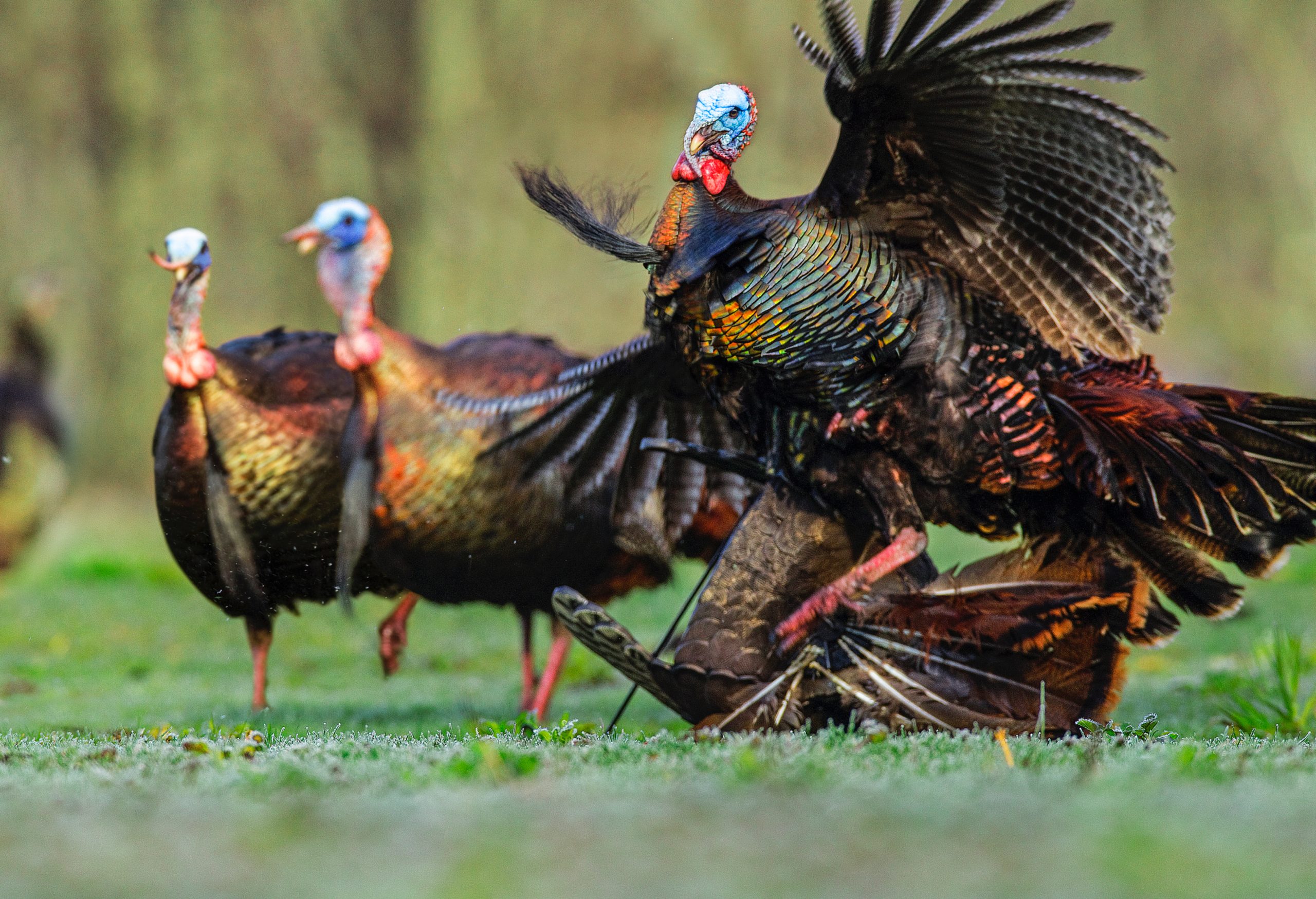
This gobbler taken on May 2, 2025 was special, not only because he is a brute weighing 23 pounds, 4 ounces but also because I think I garnered some style points as well by calling him in. Things were a bit quiet until about 7:30 a.m. when this big gobbler came in quiet; no gobbles and not following a hen. In ferociously attacking my decoys, this big boy bent two ¼-inch steel stakes from dead straight to a bend of about 30 degrees. I couldn’t imagine a gobbler being that powerful! Just how strong are wild turkey gobblers? – Thomas Haack, via email
Dr Tom's Response:
Thanks for sharing your vivid account of your spring hunt along with the photos of a truly nice gobbler and the steel decoy stakes bent by this big bird! The bent stakes are testimony to the power and overall strength of wild turkeys. Any biologist who has handled live-captured gobblers for banding can attest to their power if you do not hold the bird properly.
It takes power to launch a 20-pound bird off the ground and into flight. That power is a combination of strength and the surface area per volume relationship of their wings to body mass. Their muscle power is evident in the way gobblers fight, jumping 4 to 6 feet into the air as they attack each other over breeding rights or just to see who is boss.
Quarter-inch, round steel stakes are probably not the ideal shape when it comes to tensile strength. If it were, round steel would be used in building rather than I beams. Tensile strength is the measure of how much pressure it takes to bend or break an object – the capacity of a material to withstand loads before bending or breaking. Tensile strength is dependent on the shape of the steel item. The composition of the steel itself also comes into play.
That said, bending steel stakes placed in hard ground supporting a quality decoy is still impressive. I hope your decoys are intact after your gobbler expressed his ire at their failure to yield to his dominance.
Instead of focusing on the strength of the steel, it’s interesting to compare a wild turkey’s strength to our own human strength. Going back to high school physics, you may remember the formula “F=ma” or force equals mass times acceleration. Assuming your 23-pound gobbler was in great shape for his age, he would compare to a human age 25-30 that’s also in good physical condition.
For a wild turkey, the greatest example of force equals mass times acceleration is in moving into flight. Turkeys can accelerate from a standing start to 40 miles per hour on the wing in a few seconds. For this comparison, we’ll use the example of a turkey moving at 40 miles per hour because in order to attack your decoys the bird was moving on foot and in flight. We may be giving the gobbler a slight advantage, but that’s okay.
Our human, about 28 years old and weighing 150 pounds, is an intermediate runner; no Olympian but holding his own in 5K races pacing at 7.15 minutes per mile. His speed is 8.3 miles per hour. Your gobbler is mature and at his peak. He weighs 23.25 pounds, can run at 25 mph and fly at 55 mph for short distances. Using a weight to force calculator easily found online, we can make a comparison.
The 150-pound human exerts 252.42 Newtons running at 8.3 mph. A Newton is the force needed to accelerate one kilogram to one meter per second squared. In pounds of force, to achieve that speed the human runner exerts 56.75 pounds of force. Your gobbler in his attempt to subdue the decoys (bending the stakes in the process) may have exerted as much as 188.56 Newtons or 42.39 pounds of force. That is impressive.
Essentially, that large, mature gobbler can initiate nearly 75% as much force as a human, assuming the comparison is valid. While this is an interesting comparison, I think the show your gobbler gave you was far better than watching a 5K race. Congratulations on your success and thanks for sharing your story and photos. A good vice and a little brute force will straighten your stakes for another day in the spring woods.
Send your wild turkey questions, photos and videos to turkeycall@nwtf.net for Dr. Tom to answer.