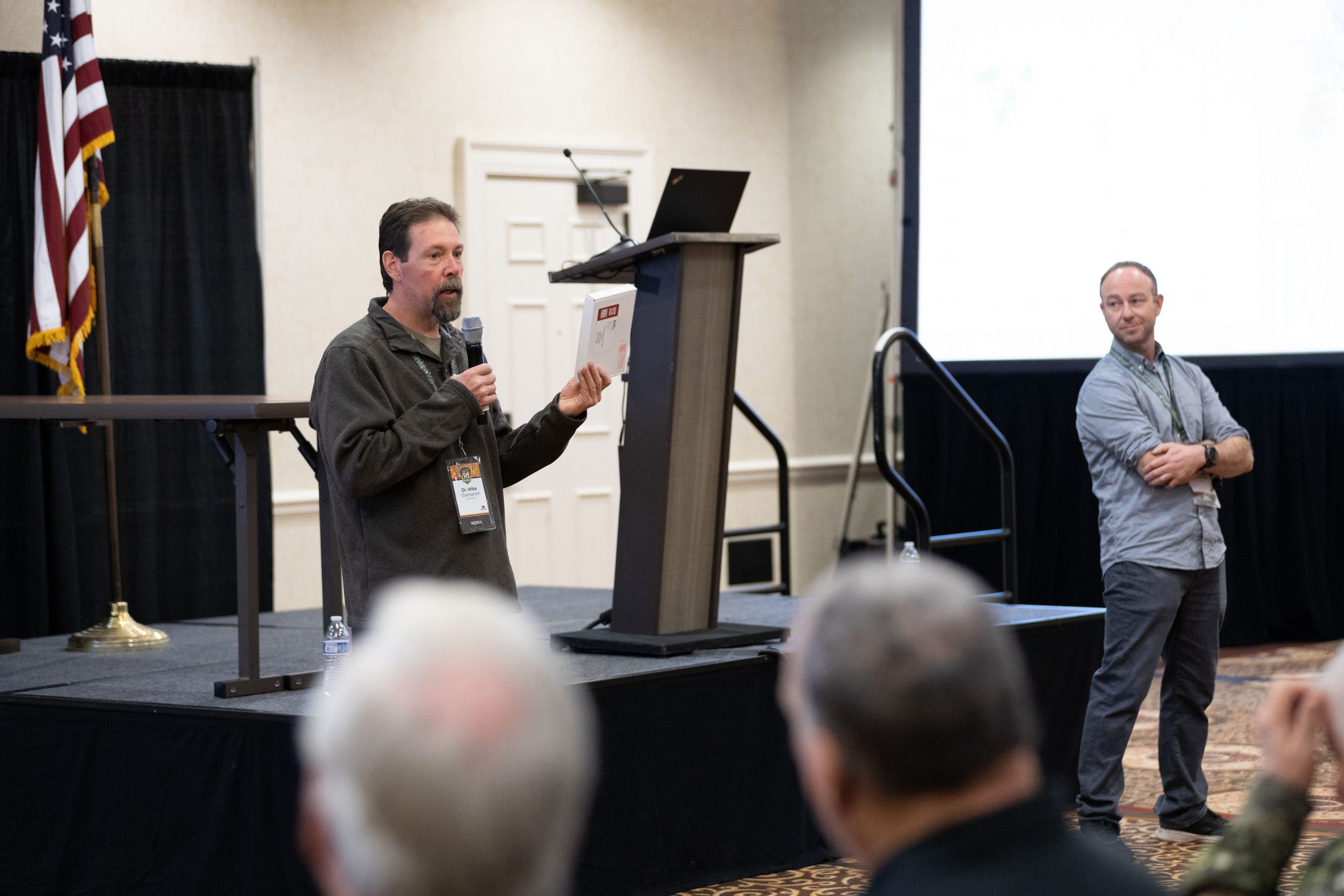
Chamberlain, Lavretsky Update Convention Attendees on Status of wildturkeyDNA
Mike Chamberlain, Ph.D., National Wild Turkey Federation distinguished professor at the University of Georgia, and Phil Lavretsky, Ph.D., associate professor and the head of the Population and Evolutionary Genetics Lab at the University of Texas El Paso, captivated audience members with updates from the wildturkeyDNA project at the NWTF’s 50th annual Convention and Sport Show.
Chamberlain and Levretsky began the event by discussing the origin of wildturkeyDNA and how the program began by seeking to better understand the origins of color variations in feathers and the potential for color phases in wild turkey populations, but they explained how the project is raising more questions and how it is quickly expanding further to evaluate nuanced and deeper questions of the wild turkey’s genealogy.
The duo pulled up a graph illustrating genetic markers and illustrated how they have established a baseline for differentiating wild turkeys from heritage breeds. The graph showed how, based on DNA characteristics, genetic markers will cluster differently. They gave the example of how domestic turkeys that you would get at, say, Costco are on one end of the graph, and how wild turkeys closely linked, like Easterns and Osceolas, cluster slightly similarly but are visibly distinct, based on the limited data.
Incoming data are showing that in many cases, turkeys with odd plumage are indeed 100% wild turkey that simply have genetic mutations that are causing the odd plumage. Chamberlain and Lavretsky are also seeing instances of heritage turkeys that are being shot by hunters and instances of harvested birds that are hybrids between wild turkeys and heritage turkeys. They are also documenting instances of wild turkeys that have truly odd plumage such as smoke and white plumage that are fully wild.
But what the limited data to date is starting to reveal is something more insidious; that is, pockets of wild turkey populations may be becoming less genetically diverse.
Chamberlain recounted how wild turkey restoration took place throughout the mid-to-late 1900s, translocating winter flocks of turkeys from one area to areas devoid of birds. The result is closely related birds living and breeding over time in isolation, which causes less genetic diversity today.
Anecdotally, this lack of genetic diversity could result in less reproductive success and, in extreme cases, potential changes in behavior, which could result in decreased survivability.
The question was brought up: “Can we relocate turkeys again to increase genetic diversity?”
Chamberlain said potentially, but that the scattergun approach of past translocation efforts is over. He suggested that if we are ever to do it again, it would have to be with an immense amount of refined genetic data, being able to offer state agencies tailored prescriptions, such as a specific number of toms and hens from specific populations with genetic characteristics that would help diversify the population in need.
Audience members were captivated to say the least, and the crowd jokingly booed when Chamberlain and Lavretsky had to conclude the event. Chamberlain let everyone know that he and Lavretsky would be on the show floor to continue the conversation.
WildturkeyDNA is spearheaded by the Wild Turkey Lab, the National Wild Turkey Federation (NWTF), Ducks Unlimited (DU), University of Texas El Paso (UTEP) and the Low Country Game Bird Foundation.
If you are interested in registering to participate in wildturkeyDNA, go to wildturkeydna.com, as the project is expanding in 2026 to evaluate genetics of wild turkeys throughout the species range.