Day Three Insights from the National Wild Turkey Symposium: Part Two
KANSAS CITY, Mo. — On Thursday afternoon of the 13th National Wild Turkey Symposium, researchers presented tools to estimate wild turkey survival and abundance, as well as cutting-edge science that pushes beyond traditional field methods and into the realm of technology-driven discovery.
Tools to Estimate Survival
The first set of afternoon presentations shifted to how researchers measure survival, reproduction and abundance, which is an increasingly important question as managers look for reliable ways to track trends and guide decisions.
One challenge facing turkey managers is accurately estimating how many birds are on the landscape, and researchers presenting in this section were excited to share their findings that may help improve this for managers.
In their study, Evaluating camera survey methods for estimating wild turkey abundance, Buckley et al. evaluated camera-trap surveys, testing this approach by using a known population of 92 leg-banded Eastern wild turkeys relocated to an area in east Texas with no other turkeys present. By using baited camera sites over a 30-day period, researchers could directly compare camera-based population estimates to the true number of birds on the ground.
Results of this study showed that the camera-based estimation methods showed bias, either overestimating or underestimating turkey abundance. Detection varied widely among individuals, with roughly half of the turkeys never photographed at all. That uneven detection, researchers explained, makes it difficult to rely on camera surveys as a stand-alone tool for turkey population monitoring. While cameras can provide useful information in some situations, the study highlighted the need for caution before applying these methods broadly across the turkey’s range.
The next presentation by Joseph Quehl, Ph.D., soil conservationist for the USDA Natural Resources Conservation Service, turned to another long-standing challenge: estimating poult survival. Traditionally, poult survival has been measured by flushing radio-tagged hens and counting poults at set intervals, but this approach can be biased when broods merge or poults are missed. An alternative method using radio-tagged individual poults can offer more precise data but raises concerns about whether handling affects survival.
By comparing both approaches side by side in Tennessee, researchers found that survival estimates from flush counts and radio-tagged poults were remarkably similar, and radio-tags themselves did not appear to directly reduce poult survival. However, poults from trapped broods experienced lower survival early on, suggesting that capture methods may need refinement. The study concluded that regular flush counts remain the most cost-effective way to estimate poult survival, while radio-tagged poults can provide valuable additional insights, such as identifying specific causes of mortality. The final presentation in this section by Duane Diefenbach, Ph.D., professor of wildlife ecology at Penn State College of Agriculture Sciences, tackled productivity data collected through turkey sightings reported by agency staff and the public. While these observations are widespread and valuable, changes in survey methods over time have made it difficult to compare long-term trends. Researchers introduced a new statistical framework that allows scientists to analyze both historical and modern data together, even when collection methods differ.
Using these models, researchers found greater variation in whether hens had poults than in how many poults were in a brood. This important distinction may reflect how environmental conditions affect turkey reproduction. The approach also allows managers to evaluate productivity trends over time and across regions, helping link changes in turkey numbers to habitat, climate or other broad-scale factors.
New and Emerging Tools
The final session highlighted emerging technologies that are opening new windows into turkey behavior and survival. Patrick Wightman, Ph.D., assistant research scientist at the University of Georgia, kicked off this section with his research on Investigating diel patterns of predation events in wild turkeys using tri-axial accelerometer data, exploring how fine-scale motion sensors can improve understanding of predation risk.
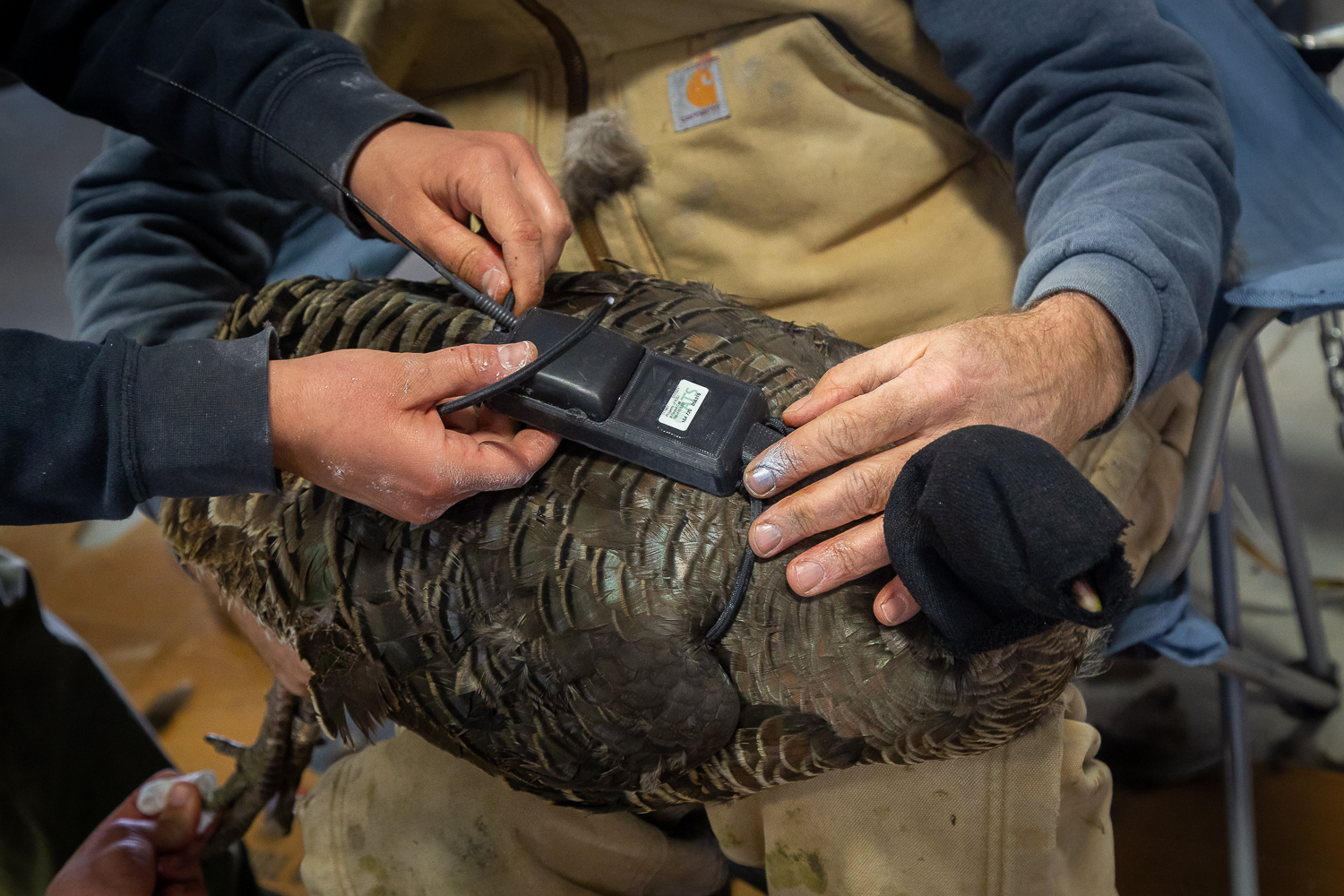
Using GPS units paired with tri-axial accelerometers, researchers were able to better understand when and how turkeys were killed by predators. By monitoring hundreds of turkeys across multiple years, they found that predation risk differed dramatically between males and females and varied by time of day and life stage.
For females, most predation during nesting and brooding occurred at night, both on the ground and while roosting. For males, predation was more common during the day, particularly in early spring. These findings suggest that predation risk is more complex than previously understood, and that management strategies focused solely on nesting cover may not address all sources of mortality.
The following presentation by Nick Bakner, Ph.D., post-doctoral researcher at Tennessee Tech University, examined Ulrey et al.’s study into how LiDAR, high-resolution laser-based mapping, can reveal fine-scale habitat features that influence nesting behavior. By analyzing forest structure and topography in South Carolina, they found that incubating hens favored mature pine stands with open understories, higher elevations and specific slope aspects. These details, often missed by traditional landcover maps, could help managers better design habitat projects that support hens during one of the most vulnerable periods of the year.
The final presentation, delivered by Mike Byrne, Ph.D., associate professor of wildlife ecology at the University of Missouri, on behalf of Schumacher et al., assessed the potential of unoccupied aerial vehicles and deep learning to survey wild turkey populations, evaluating whether UAVs and artificial intelligence can modernize population monitoring. By flying drones at night and using deep-learning algorithms to automatically detect turkeys in trees, researchers were able to estimate flock sizes with surprising accuracy. While challenges remain, such as distinguishing turkeys from vultures, the approach shows promise as a future tool that could be standardized across regions and provide new insights into turkey abundance and roosting behavior.
These presentations, followed by a Q&A session, showcased just how quickly the field is evolving. Tools that were unthinkable 20 years ago are now unlocking new perspectives on turkey behavior, habitat selection and population dynamics.
For a deeper look at the research shared from day two of the 13th National Wild Turkey Symposium and what’s to come throughout the week, explore the full list of published works.
Together, these presentations underscored a key theme of the symposium’s final day: understanding wild turkey populations depends not only on asking the right biological questions, but also on continually improving the tools used to answer them. As landscapes, pressures and technologies change, so too must the science guiding conservation. Continued research is essential for diagnosing challenges, tracking change and ensuring that wildlife managers have the best possible information to conserve wild turkeys for generations to come.
About the National Wild Turkey Federation
Since 1973, the National Wild Turkey Federation has invested over half a billion dollars into wildlife conservation and has positively impacted over 24 million acres of critical wildlife habitat. The NWTF has also invested over $10 million into wild turkey research to guide the management of the wild turkey population and to ensure sustainable populations into perpetuity. The organization continues to deliver its mission by working across boundaries on a landscape scale through its Four Shared Values: clean and abundant water, healthy forests and wildlife habitat, resilient communities and robust recreational opportunities. With the help of its dedicated members, partners and staff, the NWTF continues its work to provide Healthy Habitats and Healthy Harvests for future generations.