Double Up for Turkeys
More hunters are trying double-barreled shotguns for their vintage appeal and a great tactical advantage in the turkey woods.
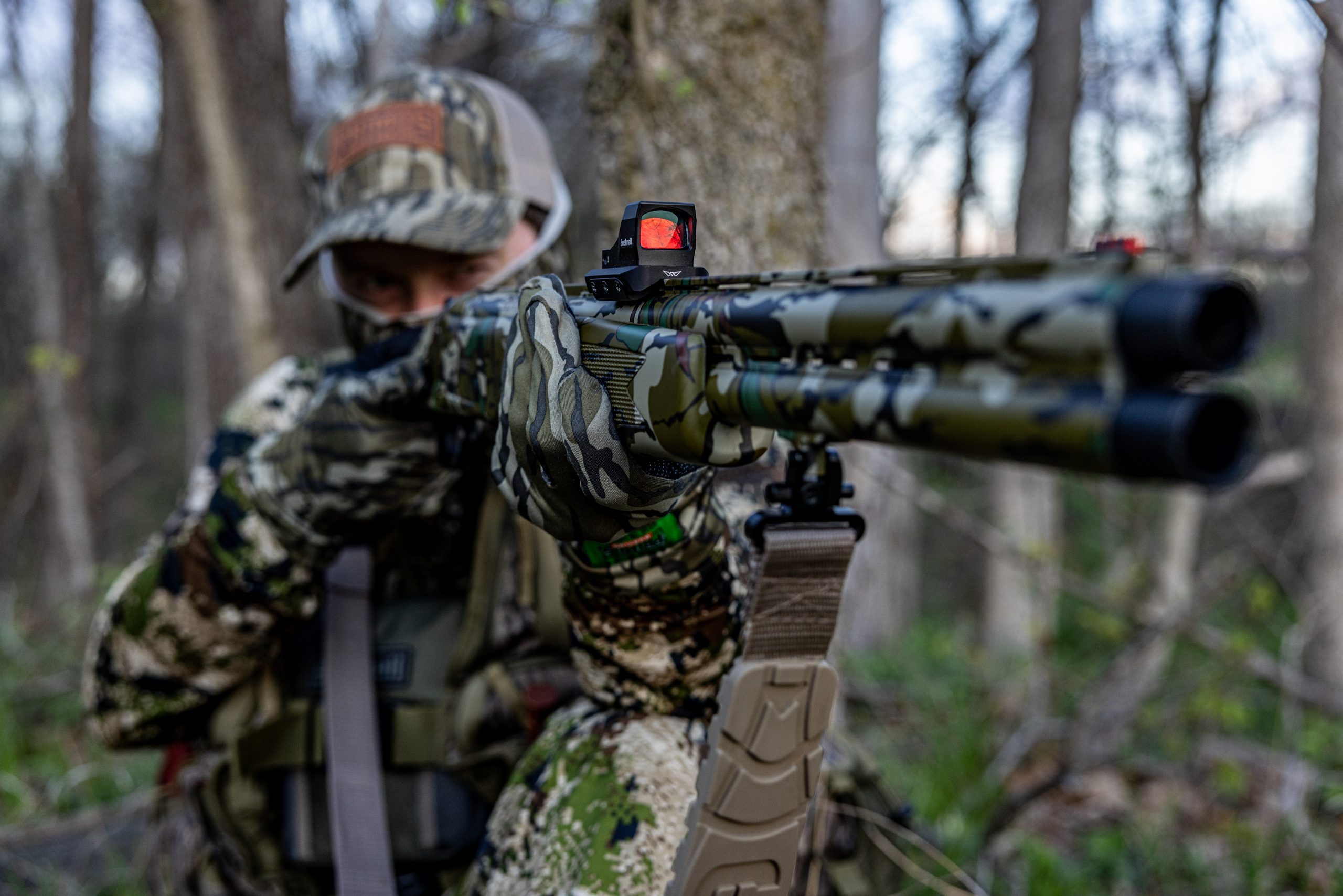
Sooner or later, every turkey hunter encounters a situation when a bird sneaks in too close. A shotgun pattern that was 16 inches wide at 40 yards becomes like shooting a rifle at 10 yards or less, and that can translate into a miss.
The solution to this problem is using a double-barrel — be it a turkey hunting model, your upland bird gun or a family heirloom — with one barrel choked for close shots and one for long shots. Switching barrels if the bird comes in too close is as easy as toggling a switch or changing triggers.
Looking at it another way, some turkey hunters use single-shots, believing that patience will give them the ideal shot, and wanting the extra challenge. A double is a mix between a single-shot and a pump or semi-automatic, and it provides a second choke option.
New Guns
It’s a good sign that a trend is catching on in the hunting world when the number of manufacturers offering a product increases. That’s the case with turkey-specific doubles. These are modern shotguns with interchangeable chokes, so there are no special ammunition considerations, although you can use a lighter load in the more open barrel for super-close shots.
Browning was the first to offer a turkey-specific double with the Cynergy Ultimate Turkey in 2016. It comes with an adjustable comb on the stock, a Bullseye rear sight and front optic sight, a short Picatinny rail for optics, and 24- or 26-inch barrels in 12-gauge 3.5-inch only. The gun is outfitted with an extra-full turkey choke and spreader choke, plus full, modified and improved-cylinder Invector Plus chokes. It’s not cheap, though, coming with a $2,800-plus MSRP.

The CZ Reaper Magnum was next on the scene in 2018. The only configuration is 12-gauge 3.5-inch with 26-inch barrels. It comes with six choke tubes, from cylinder to extra-full. It has only a front bead but sports a Picatinny rail for optics. The Reaper is lighter on the pocketbook, with an MRSP of just more than $1,000.
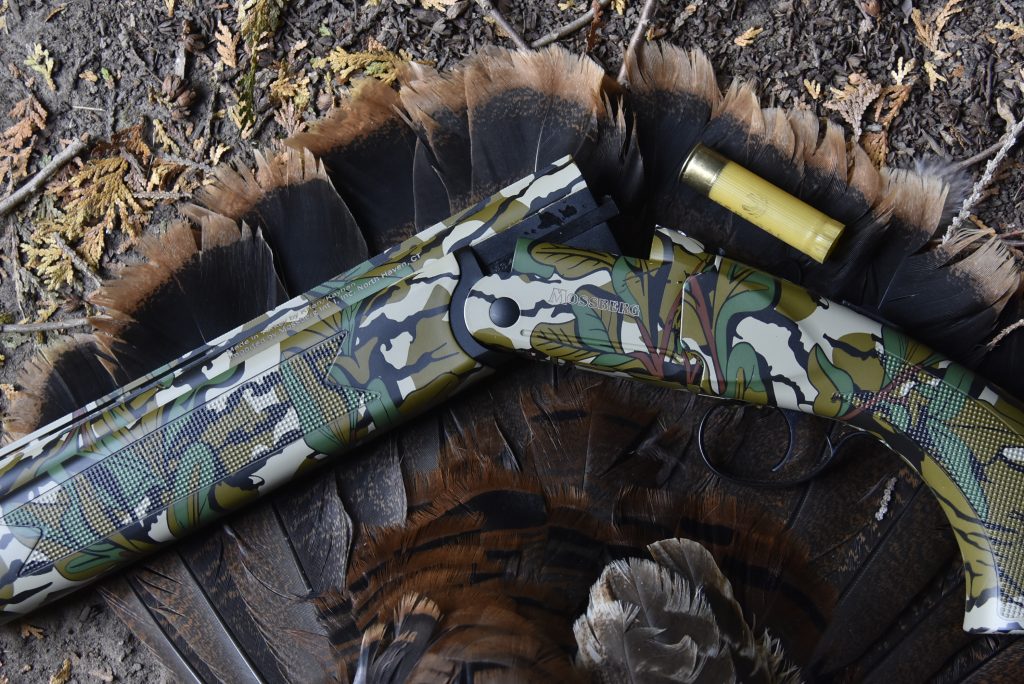
Mossberg’s International Silver Reserve Eventide-Turkey offers something the other manufacturers don’t: more than one gauge.
It’s available in 12, 20 and 28 gauge and .410 bore. All have 20-inch barrels to fill a niche for a short turkey gun, with the 20 and 28 having 3-inch chambers and the 12 with a 3.5-inch chamber. All come with two XX-full chokes and an improved-cylinder. It does not have a built-in system to mount optics.
Akkar is the latest to offer a turkey double with its Back Country Magnum. It’s available in 12-gauge only, and comes with five chokes and a Picatinny rail attachment on the rib. The retail is $1,119.
Classic Guns for Classic Hunts
For this discussion, the category of older double-barrels includes modern blued over-and-unders, older over-and-unders and side-by-sides, because the lack of matte surfaces and camouflage presents challenges.
When I hunted with a classic gun the first time, I used a blind or screen to help minimize glare on the blued barrel. Terry Smith, past president of the Canadian Wild Turkey Federation and former Roger Latham award winner, hunts with fellow Latham award winners Jim Westcott and Robert Cotiaux in Maine using black-powder Parker Brothers doubles. His advice is to move slowly and hide better with doubles.
“I try to get tucked in the trees a little bit and make sure the sun isn’t shining directly in my eyes, because if you move anything, they’ll see it, especially that first hour of the morning,” he said.
With no interchangeable chokes in the Parker Brothers guns, Smith must get birds in closer, so he puts the decoy at 15 yards.
“You want to make sure of your shot,” he said. “You want to make sure the bird is closer, especially with black powder. You have to be closer, more precise, and I take more time with black powder.”
Point of Impact
No matter the vintage of a double-barrel, take more time to pattern it to ensure the point of impact and regulation of the barrels.
Double-barrels are often set up so 60% of the pattern hits above the point of impact and 40% below, which is ideal for shooting rising birds. That differs from most turkey guns, which have a 50-50 pattern, and necessitates knowing where your gun is shooting.
In addition, it’s necessary to ensure the point of impact is the same for both barrels. Called regulation, both barrels in a double-barrel should have the same point of impact, but that isn’t always the case. By shooting at a target with both barrels and a tight choke, you can check the regulation.
Ammunition
The ammunition shot from a barrel with a modern turkey choke in a double is no different than any other turkey gun. As mentioned, when shooting an older double, be cautious of shot type. Bismuth, which is softer, can be shot in any gun, and there are modern loads such as Hevi-Shot’s Hevi-Bismuth Turkey designed specifically for chasing gobblers, as well as general-purpose bismuth loads that can produce better patterns than lead. Patterning will answer those questions.
Ammunition in the open-choked barrel is a different story and doesn’t require premium turkey loads at closer range. I tested four loads in the improved-cylinder choke in a Mossberg at 15 yards. The most uniform pattern was Hevi Triple Beard, a lead load with 7, 8 and 9 shot. It also put 10 pellets in the kill zone. Federal high-brass 2 ¾-inch, 1-ounce loads of No. 5s didn’t put as many shots on the paper, but had nine in the kill zone on my target. Winchester 3-inch pheasant loads with 1 ¼ ounces of No. 5 lead saw four pellets in the kill zone. Federal TSS 1 5/8-ounce turkey loads with Nos. 7 and 9 shot had the second-best pattern, but put only put six pellets in the kill zone. Although I didn’t have any lead Federal shells with Flite-Control wads, those might also be a good option, as they function well in more open chokes.
Optics
Some turkey hunters like optics to aid with aiming, whether traditional glass, a red-dot or reflex models. I fall in this category after experimenting with simple beads, sights and optics. Turkey Call columnist J.J. Reich is also a believer in sights.
“Sight systems are important,” he said. “An open bead at 40-plus yards is difficult to make a head shot. I would only hunt with an over-and-under if it has the capability to mount a red dot for precision aiming.”
Like hunting turkeys with a single-shot, using a double-barreled gun is still a niche market, but it’s growing, with more joining the club every year.