How Long Do Wild Turkeys Live?
Spoiler: Not that long.
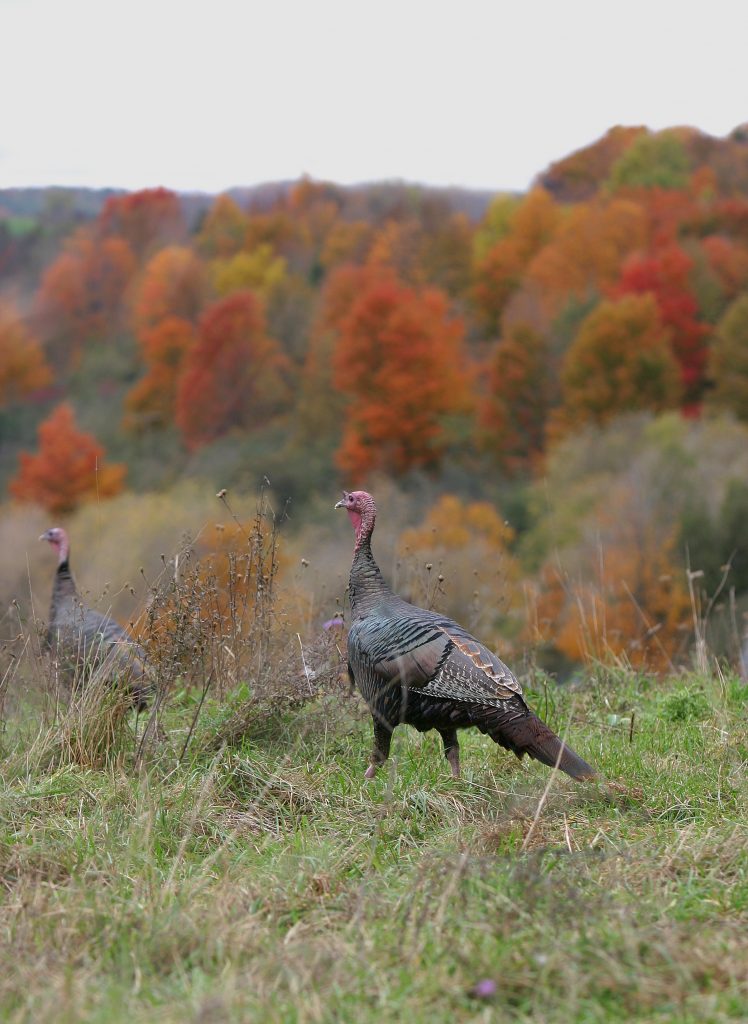
And although scientific research provides some clarity, many of the specifics about a turkey’s lifespan remain murky.
You might hear hunters describe a difficult gobbler as a “tough old bird,” but folks with a few seasons in the woods know that wild turkeys have relatively brief lifespans.
That realization prompts many questions, including how long turkeys typically live and the factors that affect their survival. And although research provides some insights, the answers aren’t always crystal clear.
First, some numbers. Several studies indicate that about 10 to 40% of turkey nests hatch, but only about 25% of hatched poults survive beyond four weeks. And even if birds beat the odds and reach adulthood, their lifespans still aren’t very well understood.
“We’re seeing that survival rates of adult males are averaging just over 50% annually, whereas hens are at about 70%,” said noted turkey researcher Dr. Michael Chamberlain, the NWTF Distinguished Professor at the University of Georgia Warnell School of Forestry and Natural Resources.
“Using those percentages, it’s easy to estimate that most males will not survive beyond about 4 years of age, whereas hens would expect to survive to about age 5 or perhaps a little older.”
The causes of those relatively brief lifespans are fairly straightforward, Chamberlain said. Predators are responsible for most hen mortalities. Hunter harvest is the most likely cause of death in most populations for adult gobblers. And scientists are just digging into the question of whether specific conditions or habitats might allow turkeys to live longer.
“However, we are seeing clearly that toms that avoid open areas and areas near hunter access points (secondary roads) once hunting starts have higher survival,” Chamberlain said. “Conversely, hens that spend more time near secondary roads and areas where humans frequent are more likely to survive the spring reproductive season.”
According to NWTF records, the oldest documented wild turkey was an Eastern gobbler from Massachusetts that lived to be at least 15 years old. The gobbler was banded as an adult in March 1979 by James Cardoza and found dead in Summer 1992. Research by Lovett E. Williams Jr. and David H. Austin in 1988 reported a hen Osceola turkey that was recaptured at 13 years old, making it the oldest for that subspecies. An adult Eastern hen banded by retired New Jersey biologist Bob Eriksen and Joe Garris in August 1981, and illegally harvested in Spring 1992, was at least 13 years old. Rio Grande turkey longevity records are 13½ for a banded Texas gobbler and 12½ for a California hen. The records for Merriam’s are 9 for a gobbler and 9½ years for a hen.
Of course, those record ages were documented and confirmed through banding efforts. Judging the age of a turkey in the field or even after it’s harvested is far more difficult. It’s easy to determine if a bird is a jake (a 1-year-old) because that turkey will have nub spurs, a short beard, uneven tailfeathers and several other identifying factors. But after a male turkey is 2 years old and older, the picture gets murky.
For example, beard length is unreliable for aging. Although a turkey’s beard grows 4 to 5 inches per year, the beard filament tips break off as a gobbler stops to feed and while on the roost, so 3- and 4-year-old gobblers likely won’t have beards that are significantly longer than those on 2-year-olds.
For generations, hunters have used spur measurements as the gold standard for guesstimating the age of a gobbler. Generally, conventional wisdom held that a bird with ¾- to 7/8-inch spurs was 2, a gobbler with sharp spurs of at least 1 inch was 3, a longbeard with spurs at 1-1/4- to 1-3/8 inches was at least 4, and a gobbler with spurs at 1½ inches or longer was at least 5. However, Chamberlain said, some studies have shown that to be a bit of a fallacy.
“Research has shown that spur length in itself is not a completely reliable way to age birds,” he said. “While it is true that a tom with a ¾-inch spur is most likely to be a 2-year-old, it’s not foolproof. We’ve documented dozens of instances where we captured and banded jakes that were subsequently harvested years later, and there isn’t a clear pattern between age and spur length. Some known-age 2-yearolds have sported spurs well over an inch, and some older birds have sported spurs under 1 inch in length.”
Certainly, most hunter-harvested gobblers are 2-year-olds, simply because they’re much more abundant than older turkeys. But if you hunt long enough, you’ll likely shoot an old, wary longbeard that survived several spring seasons. How old is he? That might be tough to say. However, you can be sure that bird is a remarkable example of survival in the wild. And really, any legally harvested adult gobbler is a trophy, whether it’s 2 or older. And maybe that question adds to the mystery and appeal of turkey hunting. You can debate the bird’s age as you relive the hunt and appreciate the miraculous natural factors that went into producing a great example of America’s No. 1 gamebird.