How the Turkey World Turns
Turkeys have a seemingly crazy annual cycle, but all the shifts and changes work to their benefit.
Turkeys go through many phases during a year, and understanding their annual cycle provides fascinating insights.
I’ve drawn my observations from The Wild Turkey: Biology and Management, particularly Dr. Bill Healy’s chapter, and my observations of 50 years. Let’s begin the wild turkey year with fall and winter flocks.
Fall and Winter
Adult gobblers tend to form small flocks. Constituents are usually siblings, other gobblers raised with the brothers and sometimes other males. Hens and their female young run together. Jakes are still finding out what they are. They might associate with gobblers, hens or just other jakes. Flocks shift in fall and winter toward winter feeding locations and winter roosts. Prime feeding locations can be forests of oak and other mast-producing trees during good mast years. Other good areas include agricultural crop fields, riparian zones along rivers or spots with human-subsidized foods, such as cattle feedlots or hay supplies. Tall trees with bare lateral limbs are attractive winter roosts. In some locations, winter flocks number in the hundreds. Large winter flocks are more common with western Rio Grande and Merriam’s turkeys, as roost sites are more limited in their ranges.
Turning to Spring
In late winter and early spring, the wild turkey world shuffles. From south to north, this transition occurs as early as late February in southern Texas and about April in New England. This is triggered by an increasing photoperiod (daylight) as the Earth tilts and spring approaches. Timing can be delayed by inclement weather or hastened by warm and sunny conditions. Adult males had been ignoring females but soon fall in love. Dawn rallies include lots of yelping and gobbling. Gobblers, eager to impress the hens, strut their stuff. Breeding can occur, but it usually gets more intense later in the season.
Most turkeys leave their winter roost sites and seek other habitat. Hens and gobblers disperse. Movements of up to 25 miles have been documented with Rio Grandes. Turkeys appear in habitats that have been void of birds much of the year. Mating increases.
Nesting
After mating, hens select a nest site and begin laying eggs. Often, nest sites have some overhanging vegetation and adjacent structure, such as a rock or log. Hens are social most of the year, but they nest isolated from other hens. In the Deep South, the mean date for the onset of egg laying is about April 1. Of course, that occurs later farther north.
Hens lay about an egg a day. They have their own biological GPS to find their nest — something at which they are uncannily good. Hens usually incubate a little when about half of their clutch is complete. The typical clutch is eight to 11 eggs.
After their clutch of eggs is complete, hens initiate almost full-time incubation. The mean time is about mid-April in the South and one to two weeks later farther north.
If gobblers haven’t been depleted or harassed too much by hunters, this is a good time to hunt. Most of the breeding has occurred. Incubating hens forsake gobblers for their nests. A gobbler often looks for hens and is vulnerable to calling. Large data sets have shown two gobbling peaks: when winter flocks break up and the onset of hen incubation. On a local level, I don’t see that consistency.
Incubating hens take an occasional break to stretch, water, defecate and feed. The usual mean incubation period for hens in the wild is about 28 days. This is a perilous time for hens, and their nests and broods. Overall, more than half of nests fail or produce no live poults. Other animals are the main cause, including wild pigs, crows and snakes. Several studies also point to raccoons and skunks.
Poult Rearing
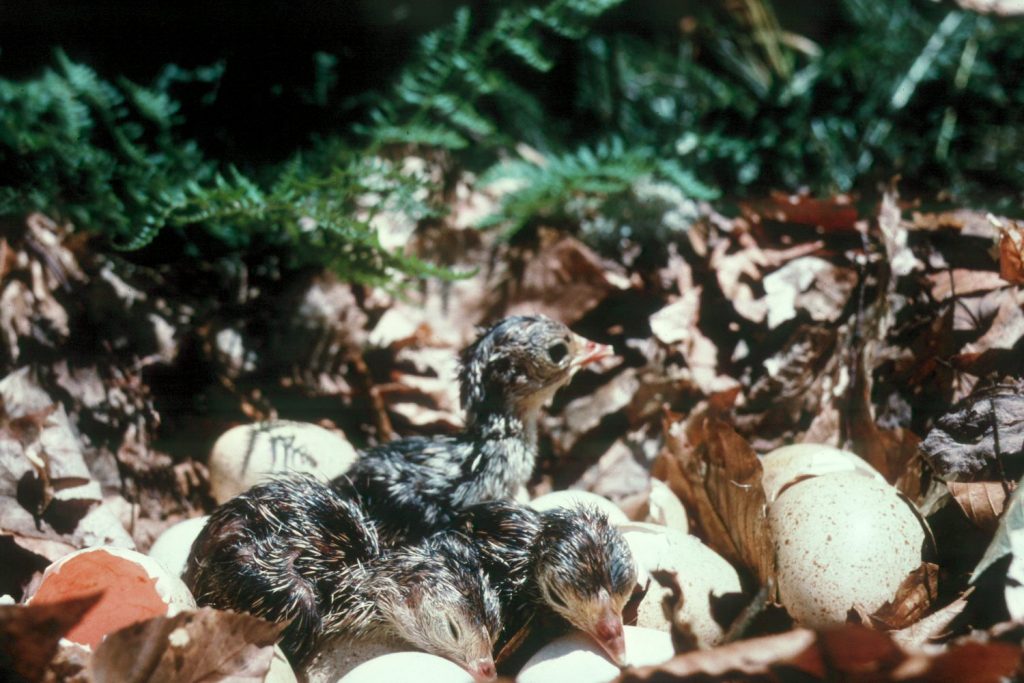
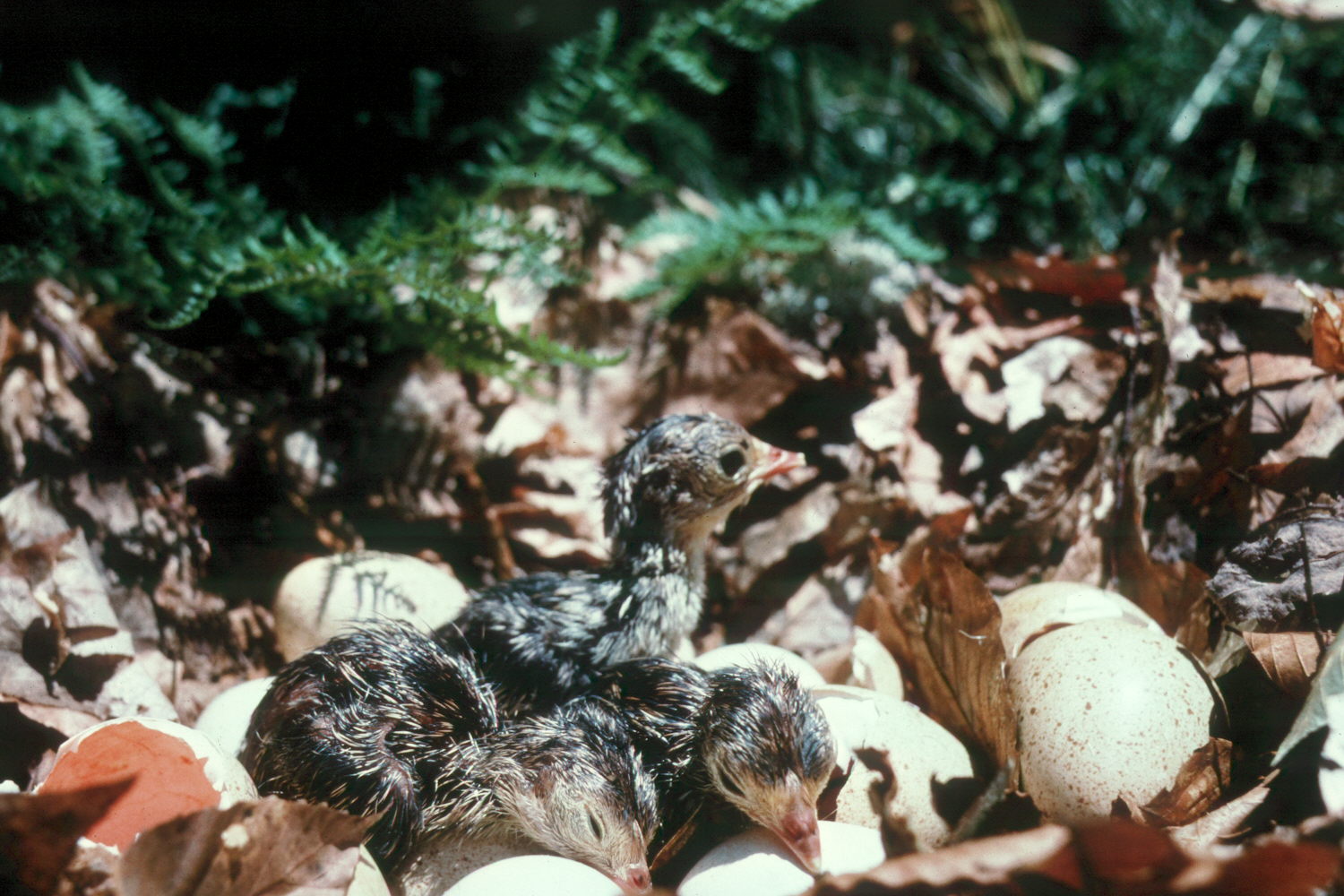
New life begins with hatching. Poults inside the egg excavate their way out, chipping away in a circular pattern with an egg tooth on their beak. This behavior is called pipping. The brood hen and excavating poults vocalize to each other to begin imprinting and to encourage the poults to speed up their shell escape. That’s why turkeys in a brood are of similar age and size. It takes about two days for the poults to hatch, dry off and imprint on the hen and siblings.
Imprinting is a process whereby the newborn identifies with the animal it sees first. It’s a very strong behavior that is lasting. Newborn poults that imprint on their brood hen are wild turkeys for life. If they see something else first, they identify with that. Two of Healy’s experiments with domestic hens demonstrated the importance of hen/poult vocalizations during hatching. In one, a deaf hen didn’t recognize her poults and killed them. In another, a hen introduced to silent dummy poults killed them. However, she then brooded them when they were mechanically equipped to peep. Amazing.
Newly hatched poults from wild turkey eggs have been imprinted on chickens and humans. It’s likely the first wild turkeys were domesticated when a human happened on and flushed the hen of a hatching clutch.
Wild turkey poults are precocial. They are born with natal down, can function and are active. That’s unlike most songbird hatchlings, which are altricial, or almost helpless. Newborn poults have a yolk sac that provides some nourishment. But they are soon underway with the brood hen. Oddly, young poults exhibit some behaviors such as strutting very early in life.
Young poults are voracious. The brood hen leads them to fields of short vegetation, ideally with abundant insects and other arthropods. Ideal habitat includes grass-forb fields taller than the poults but shorter than the brood hen and not too dense. They grow fast and have a high protein requirement to satisfy that growth. They feed on anything slow enough for them to catch and small enough to eat. Fine dining includes grasshoppers, pill bugs, butterflies and spiders. Bugs comprise the main diet the first few weeks.
Young poults can fly at about 10 days old. They start roosting in shrubs and trees with the brood hen when they’re about two or three weeks old. Poult mortality is high. Usually, about half are gone before they roost off the ground.
Late Summer
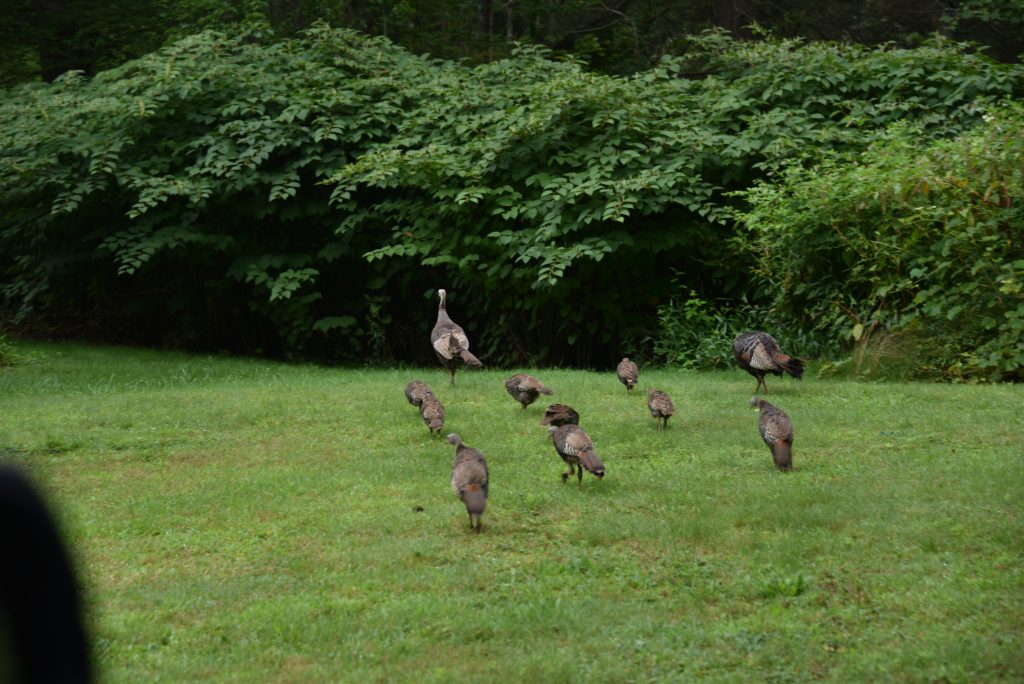
Later in summer, hens with poults and hens without poults gather in summer flocks. They usually frequent more open areas, such as pastures. Gobblers typically regroup with the guys again.
Wild turkeys do not have a defended territory as do many songbirds. They have a system of dominance hierarchy, or a pecking order, within sibling groups, gobblers and hens. Even hens will strut, peck and chase others. In late summer fall and other times, turkeys fight to establish or test their pecking order. Combatants rarely suffer, other than to their status.
Hunters disrupt this system with a jake decoy and might witness crazy behavior when they take out the alpha gobbler. This past spring, I called up two gobblers and shot the dominant one. The other flogged his downed partner, treaded my hen decoy and then attacked my jake decoy.
It might seem like a crazy wild turkey world. But it works. To their and our benefit.
Dr. Jim Dickson has played a significant role in the conservation of the wild turkey. He served as president and chairman of the NWTF. Dickson compiled and edited the most comprehensive and award-winning monograph, The Wild Turkey: Biology and Management, known as the turkey bible. He was featured on the Outdoor Channel, Animal Planet, and Outdoor Life dubbed him the Gobbler Godfather (Gobfather). He is former three-time Texas turkey calling champion. He can be reached at jgdickson14@gmail.com.