Hunting with a Wild Turkey Researcher
esearch and science, I honestly think I was more anxious about whether my hunting tactics would line up with his knowledge of the woods built from a research background.
Still, I was also eager for the chance to learn from a science-driven mind.
Gobbling Activity and Flock Dynamics
From the moment we entered the woods just to scout, my mind was running, thinking up numerous questions to ask. And while we sat under the cover of darkness, waiting for the world to wake up, my first question hit—what is peak gobbling time for the morning?
Being a part of numerous gobbling chronology papers, Wightman shared some of his knowledge. “Primarily, gobbling can start as early as 30 mins before shooting light and peaks in the window 30 minutes before sunrise to sunrise. We observe that about 75 percent of gobbling occurs before sunrise and within an hour after, then continues to decline as the day progresses.”
While this seemed like basic turkey hunting knowledge, we continued down the rabbit hole with me asking what other factors in our future could play a role — pressure, wind, precipitation.
According to Wightman, “When examining pressure effects on gobbling activity, we found no relationship for a specific barometer range and increased gobbling. Instead, research showed gobbling activity is more dependent on day-to-day changes in pressure, with greater increases associated with more gobbling.”
Rain had the largest role in suppressing gobbling activity, reducing activity by approximately 50 percent. Increased wind speeds also suppress gobbling activity, especially when over 6 mph.
Though we really only heard two birds that morning while they were on the limb (and the gobbles were nonexistent after flydown), a slight change in weather with increased winds coming in over the next couple of days had us worried that things could get difficult for the hunt.
Turkeys Have Their Own Character Traits
Later that evening, we managed to catch a couple of other birds gobbling on the roost. Though we were hunting private land for this trip, these birds sounded like they were just across the east property boundary, but near a great travel corridor. With gobbles thin for the day, we set up early the next morning in hopes of coaxing them our direction with some sweet yelping.
As the sounds of the woods came alive, we heard the two toms. After fly down, we did have a small jake cruise past the cedar tree that we were hunkered down under, but our gobblers were less responsive to us. They fired off for more than an hour and probably lobbed 60+ gobbles our way, but they never gobbled in response to our calling and seemed content where they were.
I hypothesized that they just had hens with them as we could tell they were slowly heading off to the southeast toward a block of timber and adjacent food plot.
Wightman agreed but seemed to think it was more complex.
See, research of GPS-tracked birds shows that birds aren’t all wired the same. Some have smaller home ranges and move less, and they have a lower probability of being taken by hunters. Those birds that seem more tuned to covering ground are often the birds more likely to be harvested by hunters. Conversely, predation of said birds is flipped, with the less active birds seeing a higher predation rate.
But, it also comes down to timing, Wightman, believes. The fact that not a single turkey hunting tactic works all of the time means that it’s about the temperature of the bird, which can depend on a variety of factors such as pulsating testosterone levels and the point in the breeding season. Birds one day may duck under a fence to come to the calls, but other days they just may not be feeling it or have hens who have yet to start laying or incubating a nest.
Mimic the Turkeys
With a lull in activity and wind picking up, we moved to different sections of the property, using the shadows of the trails and roads to keep our movement more hidden. And, we occasionally sat to call for a bit, positioning ourselves on bends in the road or other places where a curious turkey would be well in gun range before he realized there was no bird to be found.
Finally, creeping down a lane that led to a food plot, we spotted some turkeys using the northwest portion of the plot to give them some relief from the wind. There was at least one bird in half strut and a few others mingling around, so we sat and started to call.
Now you don’t have to be a researcher to sit in the woods and listen to birds, but putting in time trapping birds for research has presented Wightman with the opportunity to see the interactions of birds not dealing with hunting pressure, and he noted that “birds don’t just talk during breeding season; they spend a great deal of time year round just making noise and chatting amongst themselves.”
Working off this knowledge, Wightman worked up a series of light yelps, mixing in some scratching of leaves and pine straw, simulating the sounds of a bird working down the lane toward the plot.
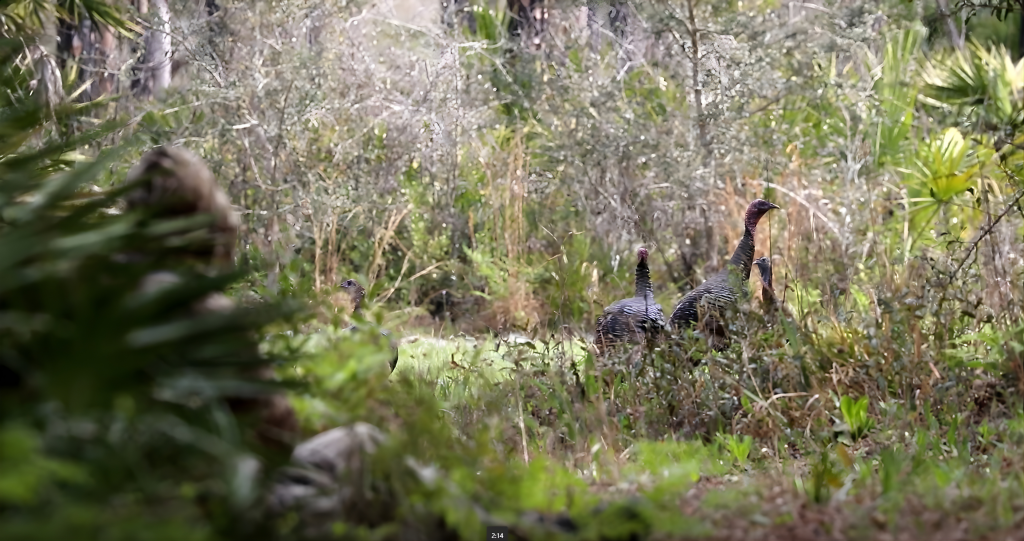
It wasn’t long before we had four jakes and a hen all standing at the end of the lane, trying to figure out where the turkey sounds were coming from.
Even once in clear view, their chatter continued despite not seeing another bird. So, we continued to sit still and occasionally mimic their sounds until they fed off.
Once again, we moved on to find another set up.
Patience is Key
As wind speeds had hit more than 15 mph and not much gobbling activity, every time we set up, we had sat longer than I probably would have sat had I been on my own.
This strategy mostly came from conversations Wightman and I had about research he had conducted where birds were GPS tagged and hunters who headed out onto the chunk of public land also were tagged with a GPS transmitter.
Overlaying the data points showed how turkeys moved with hunters on the landscape. While not a focal point of this research, one notable observation from Wightman was that turkeys often came to points where hunters had previously sat.
Some of the bigger takeaways were how much individual variation occurs and just how much ground gobblers cover.
“On average during turkey season, they may cover 300-600 acres a week and over 2,000 acres during the entire season. They’re using large areas, shifting across the landscape, and regularly changing roost sites, with a lot of variation from bird to bird. And, when hunting pressure is high, they’ll tend to move away from areas like roads and tighten up their movements, sometimes cutting space use in half.”
But Wightman noted that those changes are short-lived as birds quickly return to normal movement patterns as pressure wanes
As we neared one of the final spots we planned on hunting before lunch, a food plot that tucked back and to the left off a main trail from the road, we stopped short of the trail to lessen our chance of being spotted through the timber should a bird be there.
We had been sitting for a decent amount of time when a hen popped out from the timber adjoining the plot, and she immediately busted us.
As she headed back into the woods putting loudly, Wightman hit her with some mimicking sounds mixed with some purring, and she somewhat calmed down. Still, we heard her calling as she made her way back to the food plot.
We thought for sure the gig was up, but we decided to be patient and continue lightly calling.
Eventually the hen fed into the road in front of us, this time at a distance of more than 50 yards, and we called lightly to her just continuing to keep her calm.
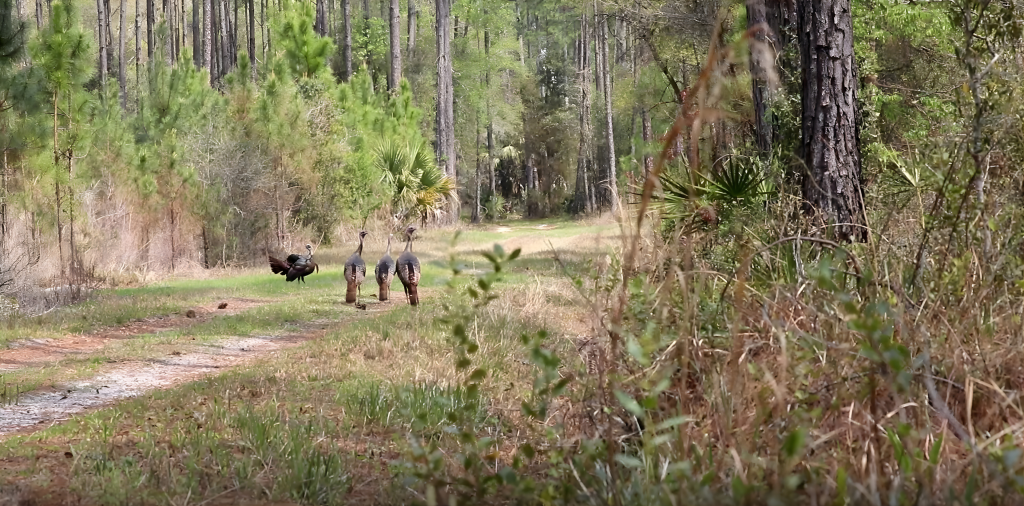
Three jakes popped out from our right as the hen fed out of sight, and it was about that time that Wightman quietly asked me if I heard drumming. Soon after, a strutter emerged from the lane that connected the food plot to the road.
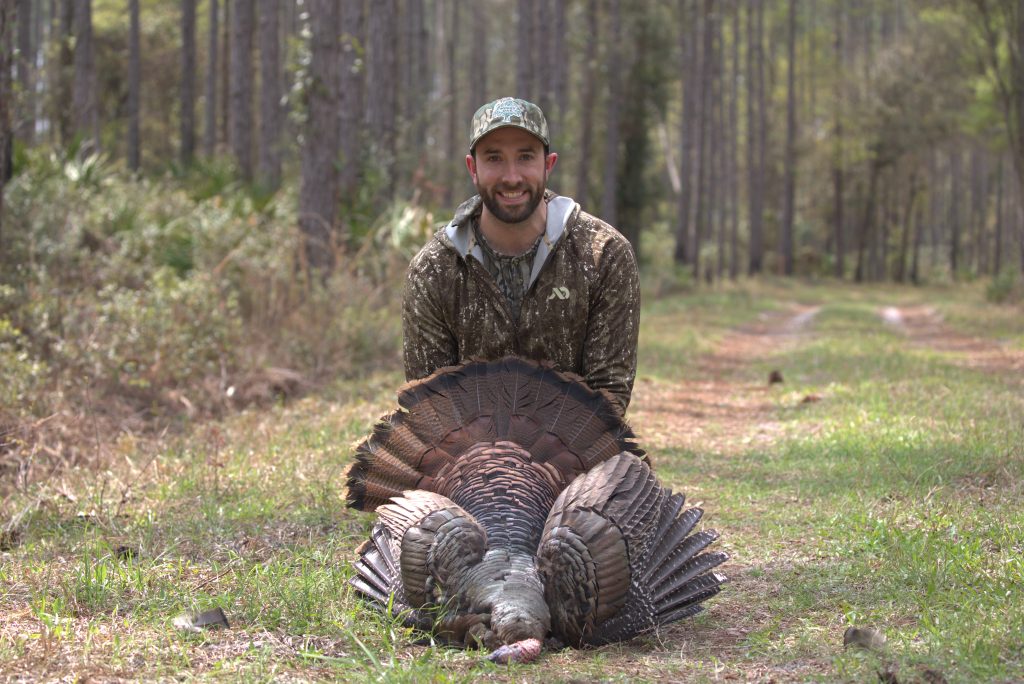
Again, not wanting to rush things and not take too far of a shot, we let the flock dynamics play out between the tom and the jakes. Asserting his dominance, he cut the distance to us in an effort to run off the jakes that were just 20 yards away. After chasing them off into the brush to our right, the tom emerged back on the main road thanks to some light yelps and purring, Wightman made a great shot.
As the elation from the successful hunt somewhat cleared, though it surely wasn’t gone immediately, Wightman and I recounted our morning hunting tactics and the great conversations had along the way.
It was interesting to see that all the topics of discussion that morning and how they played a role in Wightman harvesting a gorgeous Osceola tom.
So, as you hit the woods this spring, take note of how having patience and better understanding gobbling activity, flock dynamics and turkey behaviors — all things discussed while hunting with a researcher — can factor into potential success in turkey woods.