Inside the Net
Lessons learned testing a hog trap for wild turkey research.
The renowned success of wild turkey management achieved to date is associated with the development of capture methods for restocking and research.
Around the 1950s, researchers were called to think creatively and engineer systems that were practical and efficient for capturing multiple birds at once to supply state wildlife agencies for large-scale restocking programs.
The transplanting of wild stock resulted in the development of trapping techniques – most notably cannon-projected nets originally intended for waterfowl. Later modifications to nets, charges and cannons enhanced their effectiveness for capturing wild turkeys.
Trap types used for wild turkeys, including pole traps, drop nets, walk-in pens, box traps and roll-front traps, have seen improvements and modifications over the years. Continuous innovation benefits the wild turkey scientific community and demonstrates the intricate science and craft that is animal trapping.
Applying a New Trap
One of nine wild turkey research projects supported by a $503,618 investment in 2025 from NWTF’s national research proposals program is a new Minnesota-based study underway by the University of North Texas (UNT) in collaboration with the Minnesota Department of Natural Resources (DNR) and Three Rivers Park District.
Led by Andrew Gregory, Ph.D., principal investigator and assistant professor of wildlife spatial ecology and conservation at the UNT, the project involves capturing and handling wild turkeys to collect invaluable information on their population status in an urban landscape within the state.
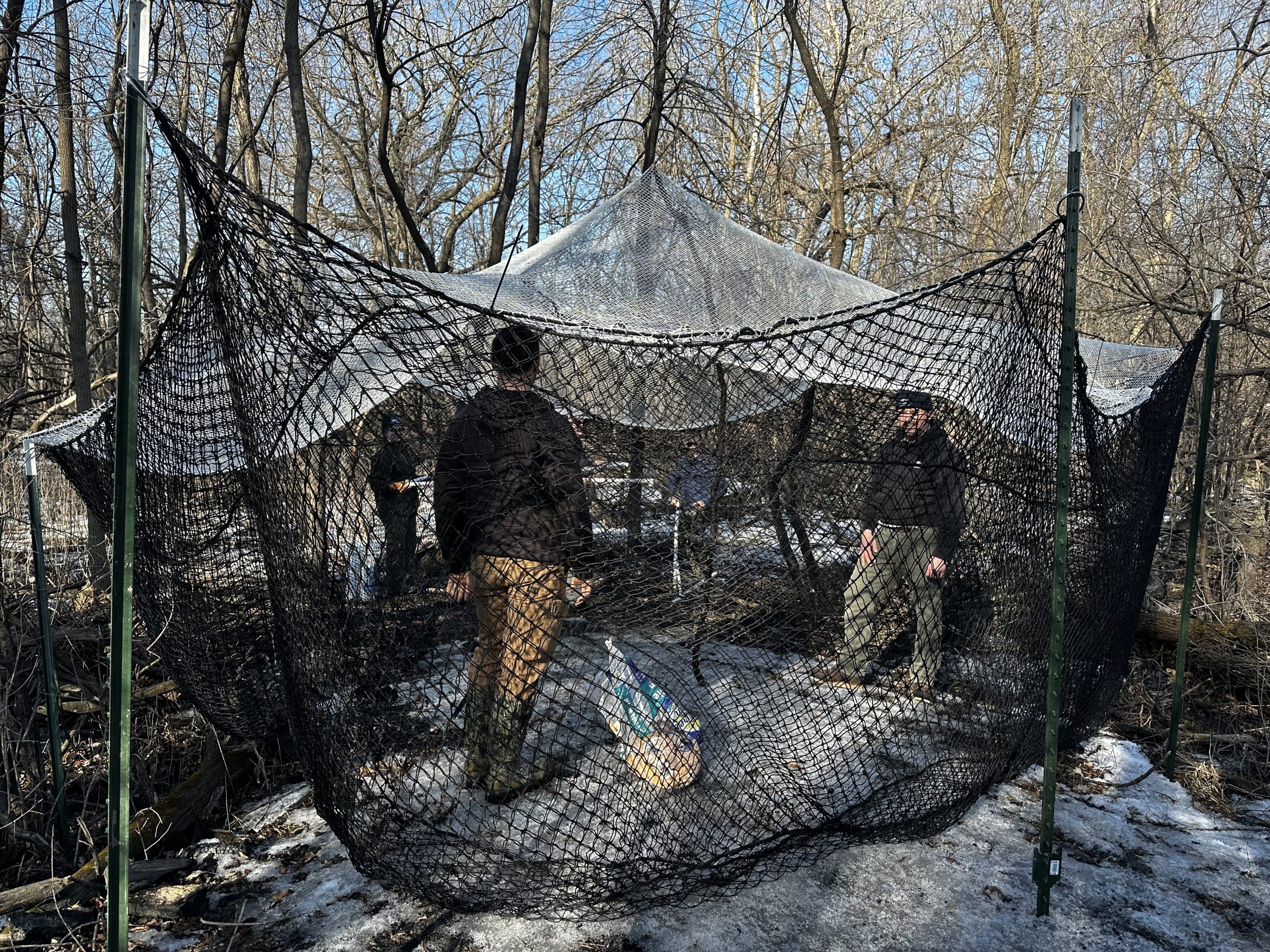
Gregory and the research team approached the study as an opportunity to demonstrate proof of concept using a modified version of an American-made net trap system: the Boar Blanket.
“It’s a giant modified drop net that, instead of dropping straight down and pinning them, it just drops around the outside,” Gregory said. “I think it’s better than a standard drop net and potentially as good and maybe better than a rocket net in some cases.”
The idea for using this capture method on wild turkeys came by accident. Prior to the initiation of the study, Eric Nelson, Wildlife Damage Program supervisor for Minnesota DNR, demonstrated the versatile use of the Boar Blanket by unintentionally catching wild turkeys while performing routine removal of invasive feral hogs.
“If this works by accident, it probably should work for real,” Gregory noted.
Boar Blanket
Designed and built by Remote Trapping Solutions, the Boar Blanket is a tension-operated, net-trap system intended for removal of feral hogs. For the purposes of the study, the standard Boar Blanket design was modified by Wildlife Dominion, a Mississippi-based company that helps develop new trapping technologies and solutions.
“The goal in all this is to come up with a better way to trap turkeys,” said Jack Robertson, co-owner of Wildlife Dominion. “We took the trap and modified it to make it work.”
Due to the study area being located in an urban environment, the research team avoided the use of traditional rocket and cannon nets due to public safety risk. Whether you’re talking about wild turkeys or hogs, net traps are a preferred method for live-capture due to the ease of use, adjustability in different habitats, and the ability to capture groups of individuals at the same time.
“The Boar Blanket design has a lot of adjustment and adaptability that makes it very quick and user-friendly,” Robertson said.
The lightweight, double-knotted net with adjustable steel ring design is strong enough to hold a sounder of feral hogs and allows for a speedy process with the ability to go from a trap up to a trap down in 10 to 15 seconds. The top portion of the trap, referred to as the cap, was adjusted to include a series of ropes that stretched across to prevent the net from sagging. The team also reduced the mesh size to prevent any birds from breaking wing feathers or getting their heads caught.
Trapping Trials
In the midst of their study’s first trapping season, some of the trapping areas became active chronic wasting disease (CWD) zones for white-tailed deer. To comply with the shift in baiting regulations, the research team further adapted the Boar Blanket by integrating a funnel chute for the birds to walk through that would simultaneously exclude deer.
“Because we were in a CWD-targeted zone, we couldn’t leave the bait open for deer to access,” Gregory explained. “That restriction limited the efficacy of that trapping method because it relies on the nets being up. We had to leave it down, and the birds had to crawl into it.”
In the first year of trapping, the research team did not catch any turkeys with the modified Boar Blanket. The wild birds were not heavily food-motivated to enter through the chute to reach the bait area in the hog trap. Gregory believed this was partially due to the abundance of food (i.e., hard mast) present on the landscape that is usually concealed by a thick layer of snow covering the ground. However, the trap showed promise in a non-CWD zone in northern Minnesota where turkeys did walk through the chute.
“We put the net up with the chute, and within about four or five days, we had turkeys inside our net,” Gregory said. “So, it will work. But you just need to have a really solid snow base, and this year in Minnesota, the snow was gone by January.”
Future Plans
Successful capture methods are the result of continuous refinement. In the wide-ranging field of animal trapping, every trap has been designed with specifications to serve a purpose best suited for capturing the target species.
“Most of the time, these traps go through two or three iterations before they get finalized,”
Robertson said. “Depending on how their success goes, this could change dramatically how people look at trapping turkeys, especially in urban environments.”
Gregory and his team look forward to a second year of field testing the modified net trap and expanding the project to surrounding areas outside of CWD target zones.
“It was a good idea in theory, and I still think it can work,” Gregory said. “I’m not ready to give up on it, but we’ll see what next year holds.”