
Made in America
Using vintage American-made side-by-side shotguns brings a nostalgic appeal to turkey hunting. And through the years, the author has also learned a few things about shooting those classics.
This story began by accident. Literally.
A turkey hunting mishap many years ago sent me down a path to find a less traumatic way to hunt gobblers. The long version of the accident tells best with a glass or two of amber liquid, but the short version goes like this:
The lesson began at dawn May 1 in a western Wisconsin woodlot and ended with a ridiculously big bang. At the time, I was shooting a modern side-by-side 12-gauge loaded with 2-ounce turkey shells, because bigger is better, right? Well, not when the gun doubles. Worse, instead of having a firm grip on the fore-end, I was only resting the shotgun on top of my left forearm as I grasped a tree branch to steady the shot.
The resulting twin blast sent the gun catapulting out of my hands, and chaos ensued. Naturally, the turkey took the worst of it, but the flying gun also broke my nose, split my cheek open, sprained my right wrist and cracked the gun’s walnut stock. It turns out that ¼-pound of lead rapidly exiting both barrels of a poorly held shotgun produces a severe and unpleasant display of Newtonian physics.
When the blood stop flowing and the swelling went down, I began referring to that bird as my “Mayday!” gobbler. And I keep the turkey’s fan and those two empty hulls on my wall as a reminder of the incident.
I wasn’t exactly gun-shy after the experience, but I did a lot of rethinking about shotguns and turkey loads. Ever the nostalgist, I wanted to keep using side-by-side shotguns, so I decided that my best option was to take a vintage American double out of the safe and try to kill a turkey with it using my own kinder, gentler handloads.
Doubling Down
The next spring, I was sitting under the same tree where the previous season’s disaster happened. But this time, I held a 1931 L.C. Smith 12-gauge. It was a logical choice because it was long-barreled and tightly choked. I worked up some low pressure 1-ounce loads using buffered No. 6 shot, which patterned very nicely at 25 yards.
They patterned so well, in fact, that I was done hunting when the Elsie’s left barrel barked at 6:30 a.m. opening morning. Better, I didn’t have any broken bones, sprains or lacerations. I also remember the reduced recoil being very welcome. For the next few years, I used that gun and those reloads to take several more gobblers. I learned that if you’re using the right loads in the right shotgun, at 20 yards or so, a turkey doesn’t need anything more than an ounce of No. 6s moving at 1,150 feet per second.
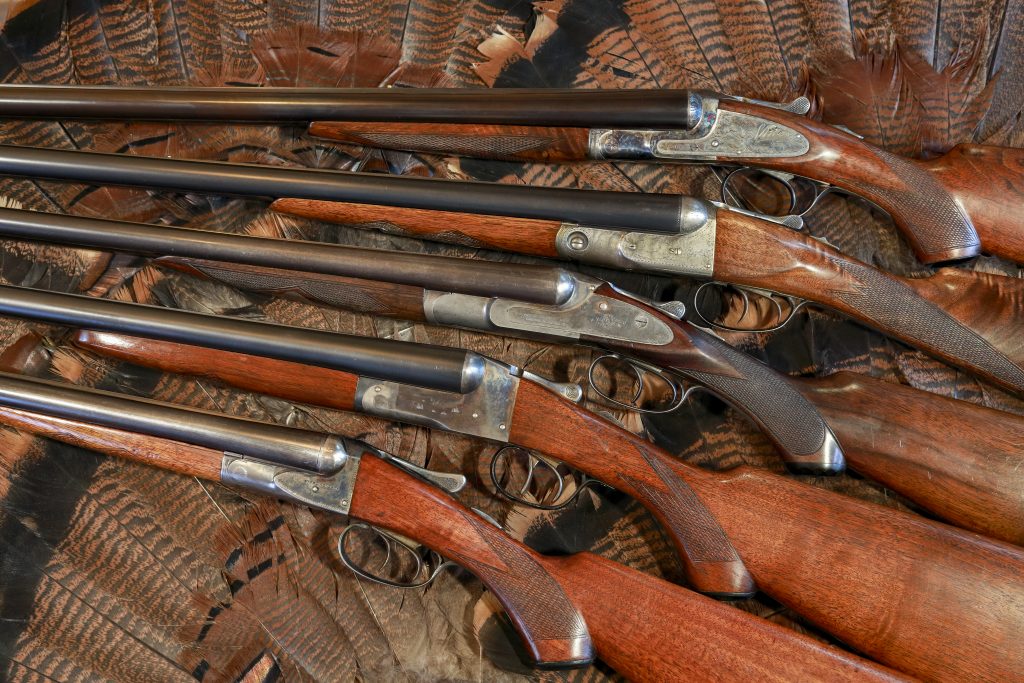
Eventually, I managed to gather a small clutch of American-made doubles. None were collectible quality, but they were all in shooting condition. That’s when I thought of it: Why not exclusively use those classic American-made side-by-sides and 1-ounce loads to hunt the quintessential American game bird? The hard part would be consistently bringing gobblers so close that an ounce of shot was enough. So, I focused on improving my calling, and I learned when it was time to shut up. Silence has probably gotten me more birds than anything else.
I already had the L.C. Smith, a Parker and a Lefever in my gun safe. With enough looking, a suitable Ithaca and A.H. Fox would come along eventually, I hoped. Those manufacturers were the most popular makers from the pre-World War II golden age of American doubles. There were many other American brands, of course, but none gained the fame of the big five.
None except Winchester and its Model 21. But Model 21s were always prohibitively expensive and therefore never the gun of the average hunter. In 1931, for example, when you could buy an Ithaca Nitro Special for $30, a Model 21 started at $69.50. Adjusted to today’s dollars, that’s a difference of more than $800.
A primary consideration for old shotguns of every design is what ammunition to use. They weren’t built to handle modern shotshell pressures, which routinely run to 11,500 pounds per square inch. Naturally, I didn’t want to repeat my Mayday snafu either, so I focused solely on loading published recipes of less than 8,000 psi. The Smith was the easiest of my doubles to feed. It liked every load I tried, and it brought down gobblers with both barrels through the years. But that wasn’t true of all the old guns.
The next shotgun I wanted to try was a Parker GH Grade 12-gauge, made in 1900. With 30-inch barrels, both choked full, it was a good choice, but my handloads weren’t consistent in it like they were in the Smith. Then I discovered a Kent factory load of tungsten-matrix No. 5s, which patterned exceptionally well. I didn’t need nontoxic shot, of course, but those patterns were just too good to pass up. Better, that Kent load maintained the vintage feel of my hunts. It’s a roll-crimped paper hull with a top card and fiber wads. And there’s just something about the aroma of spent paper hulls.
I used that Parker on turkeys for a few years, taking four mature birds with it, but those short Kent loads aren’t available in the United States any more. And that gun, with a lot of case color remaining and a beautiful piece of wood, was probably a bit too nice to carry around the perpetually wet spring turkey woods. It was time to move on.
More Doubles
Waiting in the safe I had a 1909 vintage Lefever Arms Co. 16-gauge I rarely used because, typical of that era, it has so much drop in the stock. But I wanted to prove the little 16, built on a lightweight 20-gauge frame, could do more than gather dust. After all, an ounce of No. 6s is an ounce of No. 6s, whether they are racing down a 12- or a 16-gauge barrel.
Of all the old side-by-side designs, I like Lefever’s best. They’re oddballs and much scarcer today than the other doubles. Rather than a standard hinge and pin, they use an utterly ingenious ball-and-socket joint, which is easily adjusted for wear. I also think that the slim side-plated frames are more elegant than other designs. I’ve only taken one turkey with that Lefever, however — a jake on the last day of my hunt in 2021 — because the next year, I found a very nice Nitro Special built in 1926 by Ithaca Arms.
Ithaca knew how well-respected Lefevers were when it bought Lefever Arms Co. in 1916. Soon, Ithaca was cranking out Nitros by the thousands and calling them Lefever Nitro Specials. If you’ve seen the original Lefever Arms guns and the Ithaca Lefevers, you know they don’t have much in common design-wise, other than the fact that they are both doubles.
Nitros are stout, though. Of all the old American doubles I’ve owned, that Nitro Special is the one that could probably handle modern loads. But my handloaded copper-plated No. 6s work just fine, provided I keep to my less-than-25-yard shot strategy. Of course, that means that I’ve passed on a few gobblers that refused to cooperate. With these old guns, patience is as much a requirement for me as it was for the old-timers who first used them.
The maker still missing from my arsenal was A.H. Fox. Like Parkers, Fox doubles have the classic look that all the old gun companies tried. Teddy Roosevelt had a Fox gun and raved about it often enough that Fox used his quotes in its advertising. The frames are perfectly proportioned, and mechanically, Fox guns are the most reliable of all the vintage American doubles (despite Parker’s “Old Reliable” slogan.)
I finally found a 1923 Fox Sterlingworth this past winter. The left barrel of the 16-gauge is choked a very tight full, and I couldn’t wait to get back to the turkey woods this past spring. Because the Fox has the old standard 2 9/16-inch chambers, I spent considerable pre-season time at the patterning board shooting a variety of short loads. The handloads I concocted were OK, but one factory shell — a 7,400-psi ounce of No. 6s, moving at 1,125 fps, made by RST Shotshells — created ideally uniform patterns out of that left barrel.
American Classics
The gobbler I took with that Fox this past spring was one of the trickiest birds I’ve ever encountered. He hung up three times during the morning, gobbling constantly but refusing to come any closer than about 75 yards. I’d about given up on him when he went silent. So did I. Twenty minutes later, at 19 yards, he never knew what hit him. Shutting up is something I should do more often.