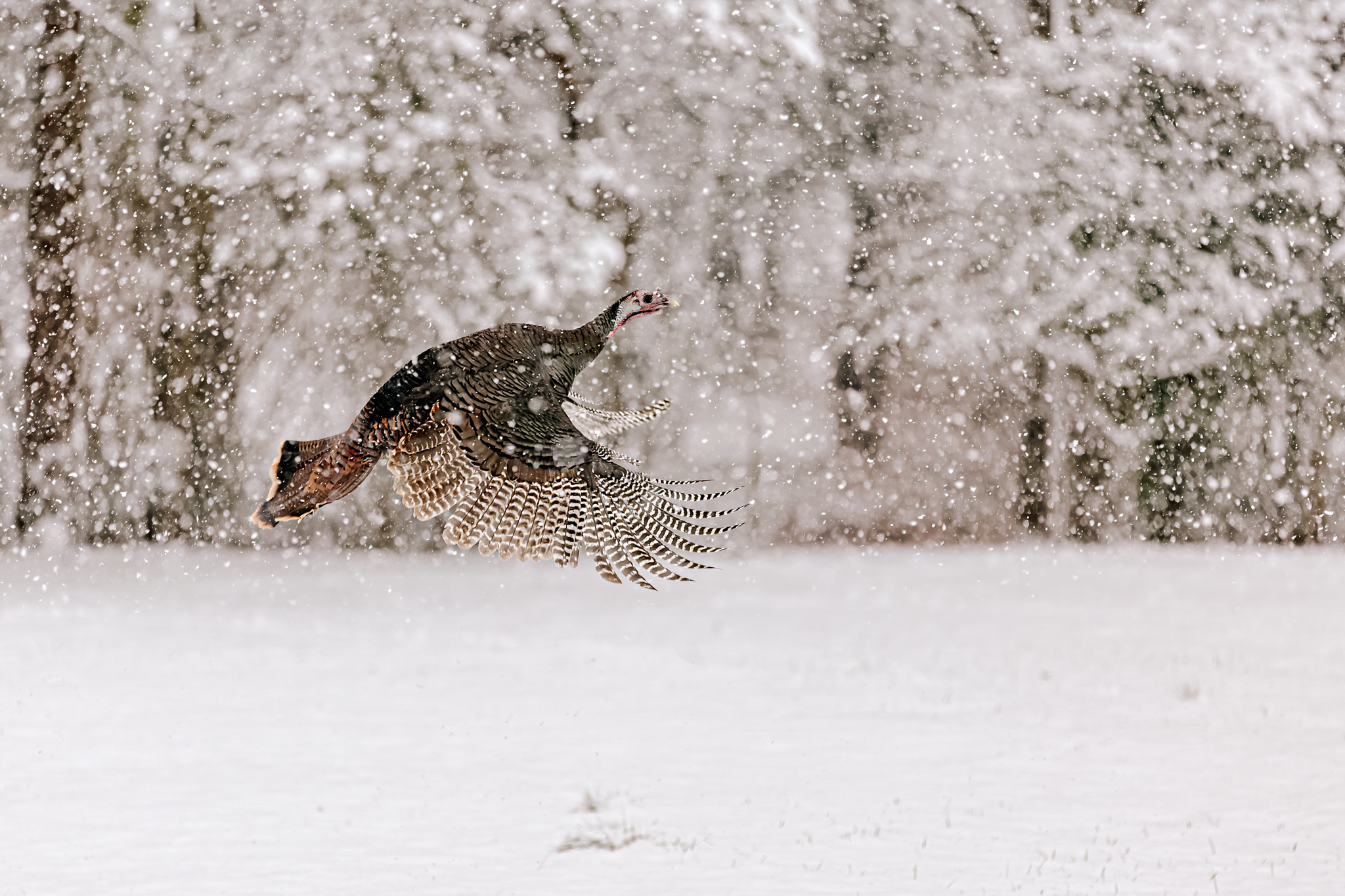
Public Invited to Help Track New Hampshire’s Winter Turkey Flocks
EDGEFIELD, S.C. — The New Hampshire Fish and Game Department is seeking the public’s help with documenting flocks of wild turkeys this winter season by participating in the 2025-26 Winter Turkey Flock Survey. The survey runs from Dec. 1 to March 31. Information regarding the status of wintering wild turkeys is important because severe weather and limited natural food supplies can present serious challenges for turkeys.
The department conducts the Winter Turkey Flock Survey each year to monitor wild turkey abundance, distribution, survival, food shortage and disease prevalence. Participation is fun and easy and can be done through the NHFG’s online portal.
The NHFG is initiating a multi-year turkey research project that will investigate wild turkey survival and harvest rates across the state this winter. Reports through this survey will be helpful in locating winter flocks to further this research effort.
This research project, funded in part through the NWTF’s 2025 investment in wild turkey research will strengthen the NHFG management decision-making process in pursuit of its primary turkey management goal, which is to regionally manage wild turkey populations using the best available science while balancing social, economic and ecological factors with environmental realities.
Biologists will be trapping and leg banding wild turkeys to collect vital information on turkey population dynamics in New Hampshire. During the trapping and banding process, agency staff are also planning to collect samples for disease testing to see if diseases pose a risk to long-term population stability.
“Leg bands fitted on birds through this project will allow biologists to measure regional harvest rates,” said Dan Ellingwood, turkey project leader with NHFG. “The rate of recovery of these bands on harvested birds will be used to validate indices used to monitor turkey population trends and to refine population estimates, strengthening long-term population management decision-making.”
Resident property owners with turkey regularly using their property can indicate on the survey form if they would be interested in allowing the department to trap turkeys on their property. All turkeys will be released on location immediately after banding.
In recent years, an average of 910 flocks and 16,488 turkeys have been reported through the Winter Flock Survey. Flock reports vary annually; during winters with less snow, birds are not as confined and congregate less around localized food sources, resulting in fewer reports. During more severe winters, however, turkeys will congregate at available food sources such as backyard birdfeeders, and flocks become more visible, increasing reporting rates.
The state’s current turkey population, estimated to be 48,000 birds, represents a modest (+6%) rebound from the year prior. This increase is largely the result of improved nesting success during the spring and summer of 2024, associated with favorable weather conditions during the nesting season.
“Participation by the public in both the Winter Flock Survey and the Summer Brood Survey greatly helps biologists continue to annually track population trends,” Ellingwood said.
Wild turkey management and research are made possible by the federal Wildlife Restoration Program, which is funded by an excise tax on the sale of firearms, ammunition and archery equipment.
About the National Wild Turkey Federation
Since 1973, the National Wild Turkey Federation has invested over half a billion dollars into wildlife conservation and has positively impacted over 24 million acres of critical wildlife habitat. The NWTF has also invested over $10 million into wild turkey research to guide the management of the wild turkey population and to ensure sustainable populations into perpetuity. The organization continues to deliver its mission by working across boundaries on a landscape scale through its Four Shared Values: clean and abundant water, healthy forests and wildlife habitat, resilient communities and robust recreational opportunities. With the help of its dedicated members, partners and staff, the NWTF continues its work to provide Healthy Habitats and Healthy Harvests for future generations.