Research Continues to Expand What We Know About Wild Turkey Nest Predators
When the National Wild Turkey Federation invested in research at the University of Nebraska-Lincoln three years ago, researchers set out to answer a relatively straightforward question: Are predators more active around areas where wild turkeys choose to nest? The answer, however, may prove to be far more complicated — and much more useful for turkey conservation.
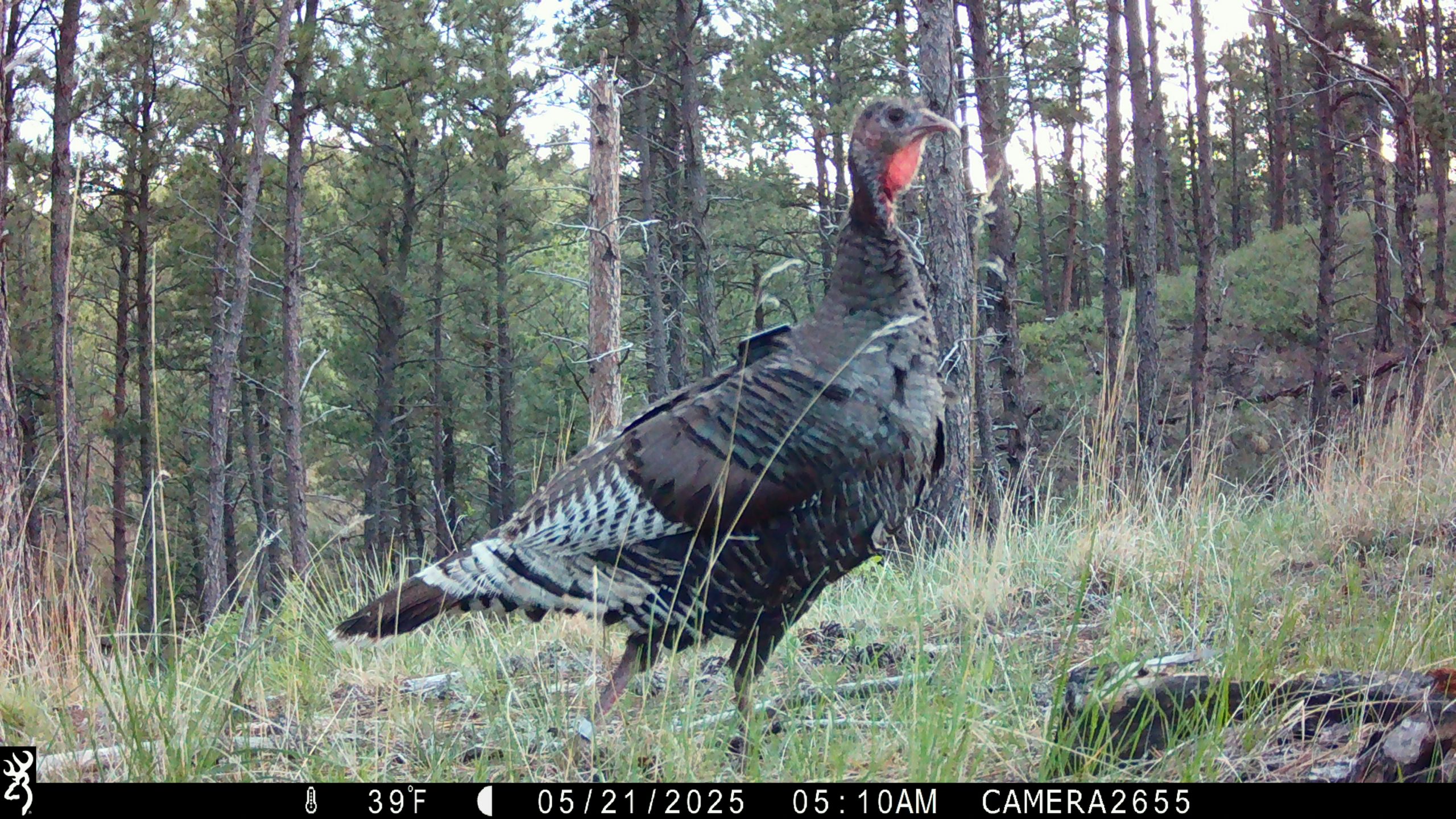
Funded through the 2023 NWTF Research Grants Program, the original study, led by Andrew Little, Ph.D., associate professor in the School of Natural Resources at the University of Nebraska-Lincoln, was part of a larger effort to understand declining wild turkey populations in Nebraska. The project is part of a collaborative research effort with the Nebraska Game and Parks Commission, bringing together researchers, wildlife managers and conservation organizations to build a more comprehensive understanding of the factors affecting wild turkeys. Researchers were particularly interested in western Nebraska, where increasingly fragmented habitat and intensive agriculture have changed the landscape available to turkeys and other wildlife.
That collaborative approach is an important part of the research. By combining the expertise, resources and perspectives of multiple researchers, agencies and conservation organizations, the team can examine turkey populations from multiple angles and develop information that is useful beyond a single research question. The research and associated funding are conducted in collaboration with NGPC, with the intent of producing science that can help inform management decisions by the agency and land managers.
NWTF funding helped researchers begin monitoring mammalian predators around known turkey nesting sites and comparable locations where turkeys were not nesting. That initial investment has since helped open the door to a much larger research effort involving hundreds of trail cameras, millions of wildlife images and a genetic approach for identifying predators at failed nests, and the work is still unfolding.
The research takes place in two different regions of western Nebraska. Southwestern Nebraska is dominated by shortgrass prairie and agriculture, including row-crop production and cattle operations. Northwestern Nebraska is characterized by the biologically unique Pine Ridge region, where ponderosa pine forests, steep slopes, bluffs and rangeland provide a very different landscape.
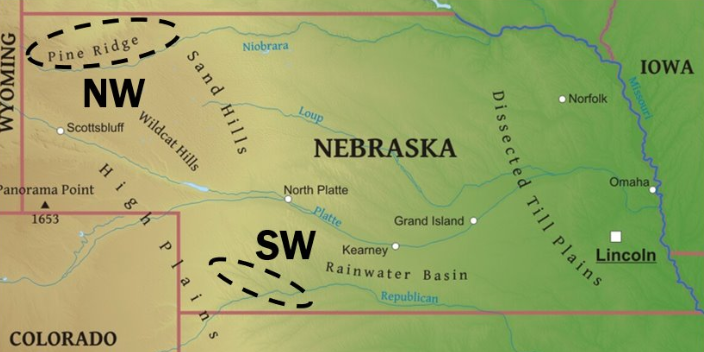
Researchers began GPS-tracking more than 245 wild turkeys across these regions as part of a larger Nebraska turkey project. This data allowed the team to identify where hens were nesting and created an opportunity to examine the predator communities sharing those landscapes.
For the nest-focused portion of the study, researchers placed three trail cameras in a triangular arrangement approximately 100 meters from an active turkey nest. A comparable camera setup was established 500 meters away in similar habitat where no nest was present. The goal was to compare predator activity between the two locations without disturbing the nesting hen.
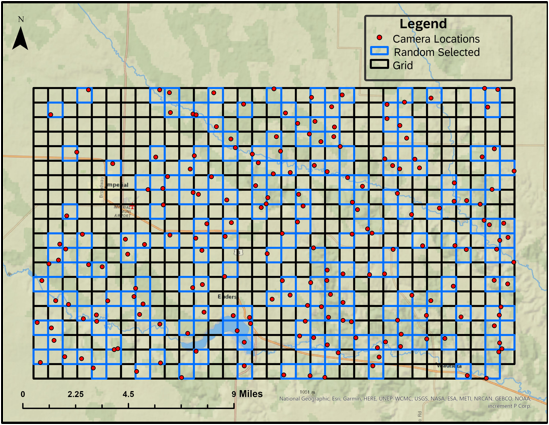
That work expanded into a much larger camera study. In southwestern Nebraska, graduate student Jade Wawers established a randomized camera grid across the landscape. The grid contained 659 one-square-kilometer cells, from which 200 were randomly selected for camera deployment. Cameras were spaced at least 500 meters apart and operated from April through August in 2024 and 2025.
Through the NWTF, Nebraska Game and Parks Commission, and the Lowcountry Game Bird Foundation, the project ultimately acquired approximately 300 trail cameras. Those cameras captured more than 8 million images.
“We captured just about everything except a mountain lion,” Wawers said. “We got coyotes, raccoons, skunks, possums, badgers, red fox and bobcat. We also got pretty much every big game species — deer, pronghorn, elk. Got lots of small game too. I have so many turkey, pheasant, quail, even grouse photos.”
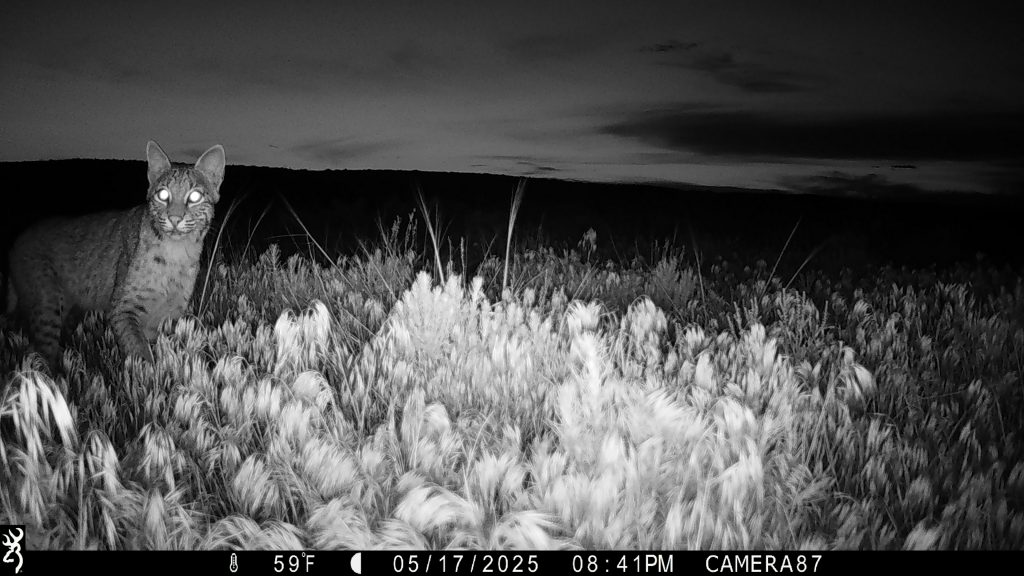
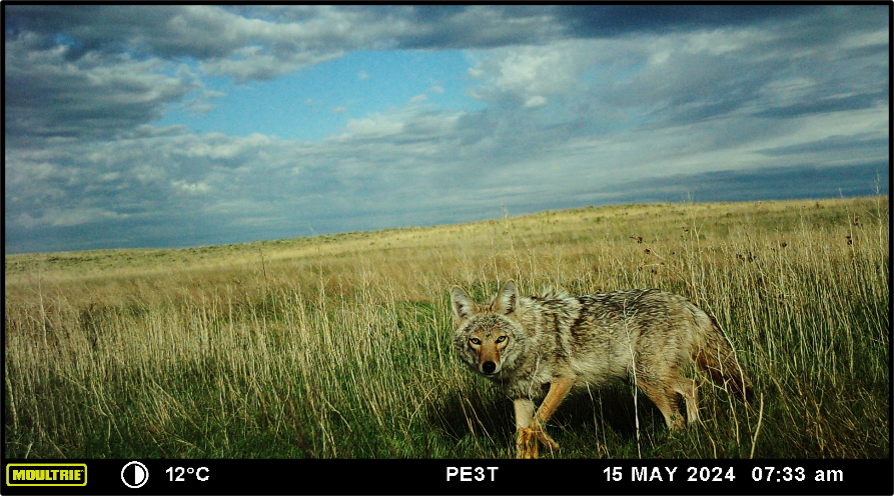
Sorting through millions of photographs would have been nearly impossible without advances in technology. Researchers are using artificial intelligence to help process the massive image dataset, allowing them to focus their time on analyzing the information rather than manually reviewing every photograph.
“This project is just a great example of how modern technology can allow researchers to ask some more finite questions and get more details,” said Patrick Wightman, Ph.D., NWTF national director of wild turkey research and science.
It is tempting to look at predators as a simple explanation for declining turkey numbers. But researchers emphasize that the relationship between predators and prey is much more complicated. In Nebraska, habitat loss, agricultural intensification and fragmentation have reduced the amount and connectivity of quality wildlife habitat. As habitat becomes more limited, predators and prey can increasingly find themselves concentrated in the same remaining patches.
"Speaking from a state agency management perspective, one of the most common concerns I hear from hunters is the impact of predators on turkey populations," said Carlie Gizel, NWTF Nebraska wild turkey program manager. "And I think oftentimes hunters and land managers are wanting the one reason for turkey decline, which we know in ecology, there rarely is one reason."
Habitat is a major piece of the puzzle. As agricultural landscapes become more fragmented, turkeys and predators can become concentrated in the same remaining patches of habitat. Researchers are studying whether that fragmentation and the amount of habitat edge influence where predators occur.
“Habitat management is predator management,” Wightman said.
The idea is straightforward: improving and connecting habitat can benefit turkeys while also spreading wildlife across the landscape rather than concentrating animals in isolated patches.
Little sees an opportunity to work with landowners to make that happen.
“You can create high-quality habitat on an individual property, but when you zoom out, it’s often an island in a sea of agriculture,” he said. “There’s very little connectivity from point A to point B.”
Strategically restoring habitat, particularly on marginal agricultural acres, could create larger and better-connected patches for turkeys and other wildlife without taking productive farmland out of operation.
Another component of the research is taking advantage of environmental DNA, or eDNA. Because wild turkeys can be highly sensitive to disturbance during nesting, researchers cannot simply place a camera directly beside a nest and watch what happens. Instead, the Nebraska team maintains a strict 100-meter buffer around active nests. That makes it difficult to determine exactly what happened when a nest fails, so genetic analysis may provide another piece of the puzzle.
After a nest has failed, researchers swab eggshells to collect trace amounts of DNA left behind by animals that contacted the eggs. These swab samples are brought to the laboratory and analyzed in in an attempt to identify the species that visited the nest.
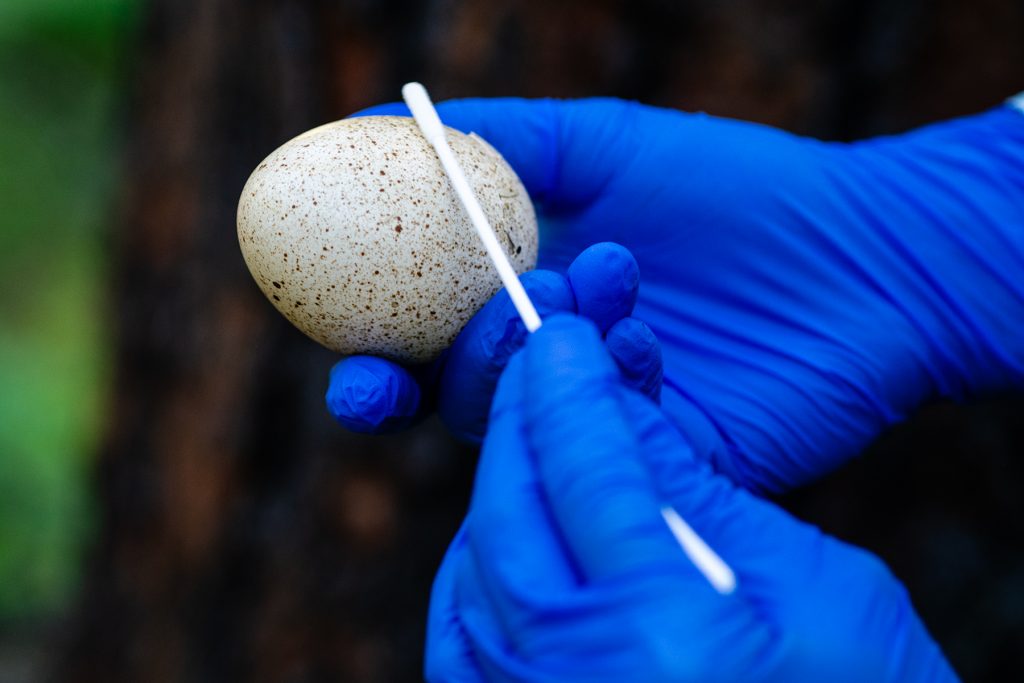
But the research is already raising new questions. Some samples may contain genetic material from more than one species. That means the technique could potentially reveal that a failed nest was visited by multiple species that either that either targeted the eggs or came across them opportunistically.
The researchers are continuing to work through the genetic analysis. The results are coming, but science takes time.
For NWTF members who helped fund this work, one of the most important updates is also one of the simplest: the researchers are still analyzing the data. After collecting millions of images, processing genetic samples and building the statistical models necessary to answer the research questions, the team is not yet ready to announce definitive results.
“We don't expect to see any published hard results until four or five years post-funding these projects,” Wightman said.
That wait is part of the scientific process. As Little explained, simply working through more than 8 million images took months before researchers could begin building the models needed to answer their questions.
But the investment has already paid off by turning a focused research question into a rich dataset that can help answer future questions about turkeys, predators and habitat.
“The really cool thing is it's this kind of historic database that you can always tap back into once you've quantified the predators and then use it to answer different questions,” Wightman said.
Ultimately, the goal isn't simply to determine which predators are on the landscape. It's to understand how predators, turkeys and habitat interact and use that knowledge to guide conservation. Just as importantly, the research is intended to provide NGPC and land managers with information they can use when making decisions about turkey management, habitat and other conservation priorities.
For Nebraska's largely privately owned landscape, that means working with landowners will be critical. Researchers see opportunities to strategically restore habitat on portions of agricultural operations, particularly marginal acres that may not be highly productive for crops. Connecting isolated patches of habitat across neighboring properties could provide even greater benefits.
“Landowners have a lot of power,” Gizel said. “The producers on our landscapes have immense influence and potential to create habitat.”
Those efforts don't necessarily have to come at the expense of agricultural production.
Researchers emphasize the potential for “win-win” conservation approaches that allow producers to maintain their operations while improving habitat for turkeys and other wildlife. Landowners interested in improving habitat can start by contacting a local wildlife biologist, Natural Resources Conservation Service office or NWTF chapter to learn about potential conservation opportunities and funding.
The NWTF’s investment has given researchers the equipment and resources to ask questions that would have been difficult to answer otherwise. What began as a focused look at predators around turkey nests has grown into a much larger effort examining predator communities, habitat fragmentation and even the genetic traces predators leave behind on turkey eggs.
The final results are still being developed, but the foundation is in place. Every camera image analyzed, GPS location recorded and eggshell tested adds to our understanding of what wild turkeys need to successfully reproduce in agricultural landscapes.
And that is exactly what NWTF members' research dollars are designed to do: turn today's investment into tomorrow's conservation solutions.
This project was one of 10 research projects funded by NWTF in 2023, when the organization invested $582,374 in research across nine states. Since 2022, NWTF and its state chapters have significantly increased investments in wild turkey research to help address population challenges and provide the science needed to guide future management.