The Cost of Raising Poults: New Research Reveals the Survival Trade-Offs Facing Wild Turkey Hens
Every spring, hens across the country begin one of the most demanding stretches of their lives.
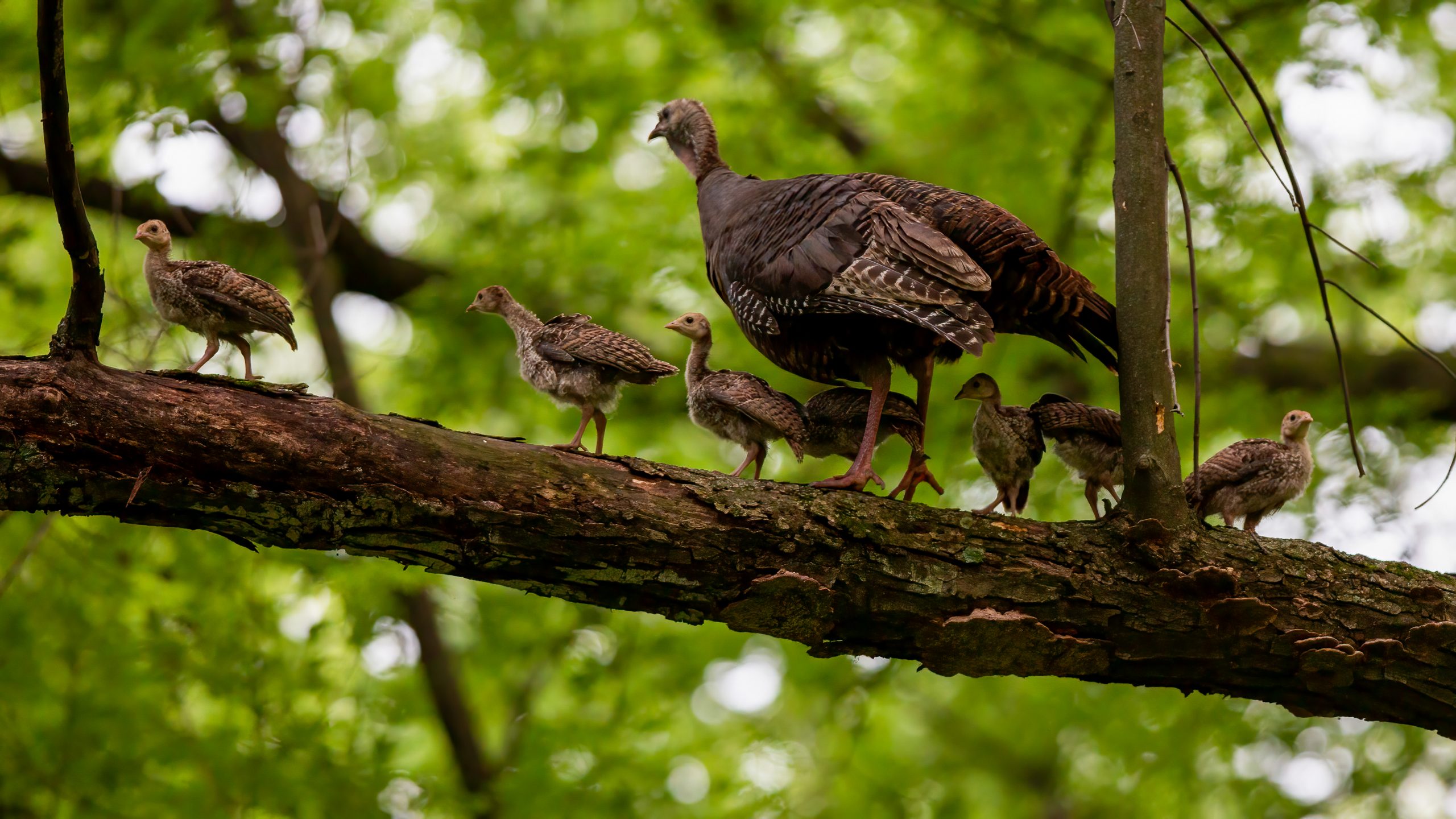
They build nests, lay eggs, spend weeks incubating and then guide fragile broods through their first days on the landscape. It’s the process that sustains wild turkey populations, but new research shows it also comes with real risks for the hens themselves.
A recently published study examining female wild turkey survival across the Southeastern United States reveals an important truth about turkey ecology: raising the next generation comes at a cost.
By studying nearly a decade of data from GPS-tagged birds, researchers uncovered how different stages of reproduction influence the survival of hens and what that means for the long-term health of turkey populations.
“What really stands out to me about this study is the power of collaboration,” said Patrick Wightman, NWTF national director of wild turkey research. “By combining data from multiple long-term research projects, we were able to analyze one of the largest known-fate GPS datasets ever assembled for female wild turkeys.”
To understand how reproduction affects survival, researchers monitored 942 female wild turkeys between 2014 and 2023 across study sites in Louisiana, Georgia and South Carolina.
“Large sample sizes like this allow us to draw stronger conclusions about how wild turkeys respond to different life stages,” Wightman said. “It also highlights the importance of standardized data collection across studies so we can continue answering questions about turkey populations at broad spatial scales.”
Each bird was fitted with a GPS transmitter that recorded movements throughout the breeding season. Researchers then tracked survival and reproductive behavior during the most critical months of the year, from March through August.
Using these data, scientists evaluated survival across several reproductive stages:
- Egg laying
- Incubation
- Brood-rearing
- Periods when hens were not actively reproducing
This approach allowed researchers to examine a central concept in wildlife biology known as a reproductive trade-off, or the balance animals must strike between producing offspring and ensuring their own survival.
The research revealed a clear pattern: hens actively engaged in reproduction had slightly lower survival rates than hens that were not nesting or raising poults.
Across the breeding season, reproductively active hens had about 67–69% survival while non-reproductive hens had about 76% survival.
In other words, hens investing energy into nesting and raising poults faced greater mortality risk.
This makes sense when you consider what nesting requires. A hen spends long periods on the ground incubating eggs, often remaining on the nest overnight for weeks. This behavior reduces movement and increases vulnerability to predators.
Among all reproductive stages, incubation proved to be one of the most dangerous times for hens.
Researchers found that daily survival rates were lowest while hens were incubating nests, and the risk increased as incubation progressed. Toward the end of the roughly four-week incubation period, hens become increasingly committed to the nest, spending more time sitting on eggs and taking fewer breaks.
Biologists believe this reflects a behavioral strategy sometimes called “terminal investment.” As hatching approaches, hens are less willing to abandon the nest, even when risk increases.
If the nest succeeds, a hen’s work isn’t finished, and the danger doesn’t disappear.
The study also showed survival costs associated with brood-rearing, particularly during the first two weeks after hatching. Wild turkey poults cannot fly for about two weeks. During that time:
- Hens must roost on the ground with their poults.
- They must constantly move to find insects and food.
- They must lead young birds that are highly vulnerable to predators.
All of this increases exposure and risk. As poults grow and gain the ability to fly, survival rates for hens begin to improve.
The research also examined whether renesting affects survival.
Wild turkeys often attempt another nest if the first fails. But each attempt requires more energy and exposes the hen to predators again. The study found that hens making multiple nesting attempts tended to have slightly lower survival, reinforcing the idea that reproductive effort carries cumulative costs.
“This study shows that reproduction does carry survival costs for hens, but it also reminds us that adult female survival in these populations remains relatively strong for a ground-nesting bird,” Wightman said. “That suggests improving nest success and poult survival may be just as important as adult survival when it comes to sustaining turkey populations.”
Authored by Nicholas Bakner, Ph.D., Dylan Bakner, Ph.D., Allison Keever, James Martin, Ph.D., Patrick Wightman, Ph.D., Erin Ulrey, Nick Gulotta, Bret Collier, Ph.D. and Michael Chamberlain, Ph.D., this research is another peice in the puzzle of improving wild turkey management across the country.
Why This Research Matters
Wild turkey populations in many parts of the country have experienced declines in productivity over the past two decades, with fewer poults surviving each year. Understanding how reproduction affects hen survival helps biologists answer a critical question:
What factors are limiting turkey populations?
If hens face higher mortality while nesting or raising broods, habitat conditions during these stages become even more important.
Healthy turkey habitat must provide secure nesting cover, quality brood habitat rich in insects and vegetation structure that helps hens avoid predators. When those elements are present, hens can successfully raise poults while minimizing risk.
The Bigger Picture for Wild Turkey Conservation
One of the most interesting findings from the study is that female survival rates appear relatively strong, even in areas where productivity has declined.
This suggests that current population challenges may be driven more by nest success and poult survival than by adult hen mortality.
For conservationists, that reinforces the importance of improving nesting and brood habitat — work that the National Wild Turkey Federation continues to prioritize through habitat management across the country.
Every successful nest and brood is the product of a hen navigating weeks of risk and energy demands. Understanding those challenges helps biologists, land managers and conservation organizations ensure wild turkeys continue to thrive for generations to come.