Turkey Docs Discuss the Future of the Wild Turkey with NWTF Convention Attendees
Two of the most renowned wild turkey researchers engaged NWTF convention attendees, answering thought-provoking questions and inspiring a culture of conservation.
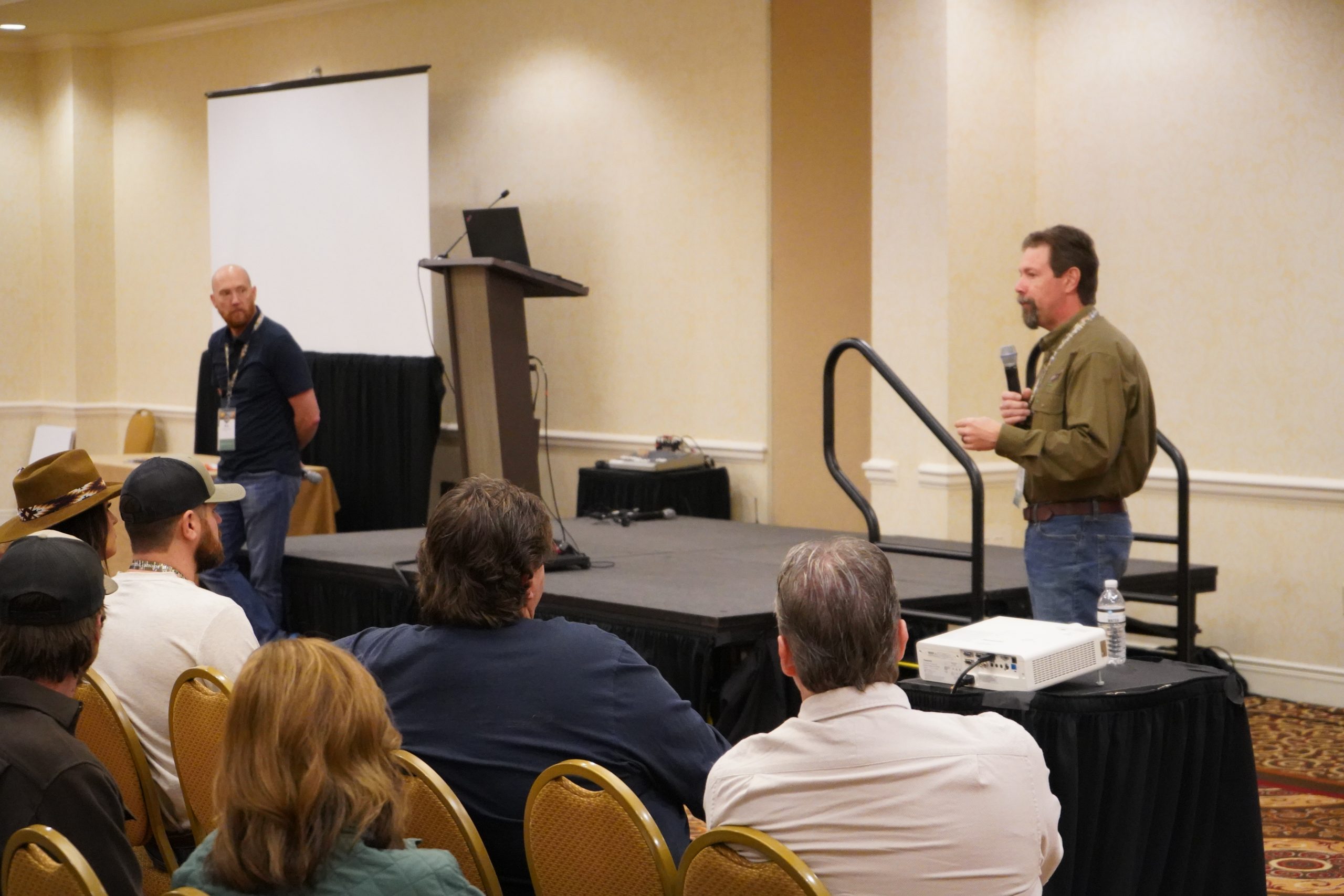
Mike Chamberlain, Ph.D., and Bret Collier, Ph.D., held a wild turkey research seminar for NWTF convention and sport show guests.
The two started the seminar by highlighting that they will both be retiring from their professorships soon. They emphasized the immense need for game-species-focused academic researchers who will continue investigating ecological challenges and offer effective management solutions.
After illuminating the need for the next generation of researchers, Chamberlain and Collier let the audience steer the conversation for the duration of the seminar.
"We're going to just open it up to the floor this time," Chamberlain said. "Let's talk about something contentious."
There was no shortage of questions.
One of the audience members discussed how he witnessed his state agency applying prescribed fire during the nesting season and asked why the agency would be doing that if they risk burning up nests.
Chamberlain and Collier explained some of the nuances around burning during nesting season.
First and foremost, burns are usually occurring in areas where turkeys are not nesting, the turkey docs explained. Areas where prescribed fire is being implemented have likely gone 3-plus years since the last prescribed fire, meaning hens are most likely not using it for nesting.
Hens are primarily nesting in areas that have been burned more recently, which means that block of landscape would not be subjected to burning for another year or two.
"We rarely burn nests," Collier said in short. "Fire on the landscape creates the vegetative communities we want for turkeys."
However, Chamberlain did mention some research suggesting large-scale prescribed fires on over 500 acres at a time could have some detrimental effects. He also discussed the difficulty for state agencies to balance fuel reduction quotas with wildlife management efforts.
Another audience member asked how we inform landowners in our communities about management solutions that are available to help increase wild turkey numbers. The audience member suggested that some of his neighboring landowners are stuck in their ways about what they think is causing the decline and may not focus on the correct solutions.
The turkey docs said it's about conversation, not confrontation.
Chamberlain also noted a communication problem; landowners often don't know what habitat solutions are available through cost-share programs. He used his recent discussion with the USDA Natural Resources Conservation Service Chief as an example.
"The chief told me there is a pool of $92 million available to private landowners to help them with habitat improvements on their property, but they just don't know that is an option for them."
Other discussions included theorizing about more insidious causes of declines – such as pesticide use and disease prevalence – but the turkey docs emphasized the need for data, not guesswork.
The two finished the seminar by telling everyone to feel free to come up to them at any point during the NWTF's Convention and Sport Show to talk wild turkeys.
They also concluded by telling the audience to be bold and challenge someone's assertion about wild turkey declines or habitat management practices. They noted a fundamental difference between peer-reviewed research and the info someone's granddad told them.
Chamberlain and Collier's ability to succinctly discuss some of the biggest questions surrounding wild turkey ecology captivated the room full of intrigued turkey hunters. The thirst for knowledge among the turkey hunting community paints a bright picture as we move forward to conserve the bird we cherish.
Chamberlain is a Terrell Distinguished Professor of Wildlife Ecology and Management at the University of Georgia, and Collier is an Associate Professor at the Louisiana State University School of Renewable Natural Resource.