
Gould’s Subspecies Hunt Guide
As part of our 2026 Turkey Kickoff Week, we are breaking out our national Spring Hunt Guide by subspecies, allowing hunters to learn about specific subspecies and where to hunt them.
Identification
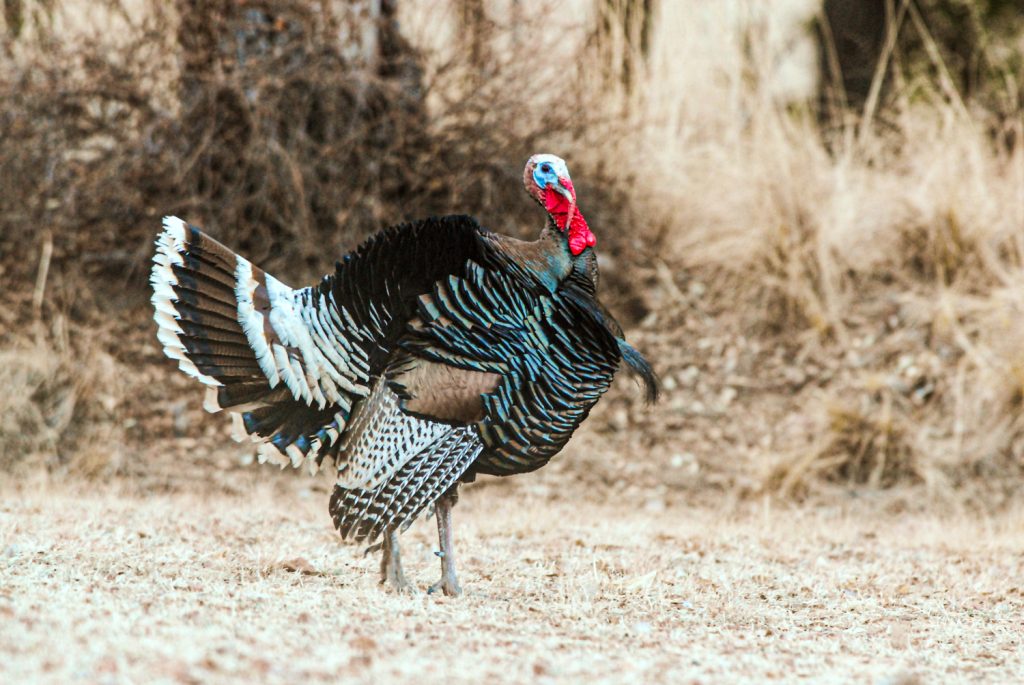
Gould’s wild turkeys are named after John Gould, an English ornithologist who collected the first recorded Gould’s turkey specimen in Mexico. They are known for their shy and elusive behavior, which adds to their allure. Compared to other turkey subspecies, they are generally warier and less accustomed to human presence.
Males weigh an average of 20 to 25 pounds, while hens come in between eight to 12 pounds. They also have the largest feet, longest legs and longest central tail feathers of all subspecies. But their spurs and beards are typically shorter, with an average tom’s beard measuring about 8.5 inches and spurs less than half an inch. Gould’s tend to rub both their spurs and beard down in the steep rocky terrain. They have distinctive, white-tipped tail fan feathers and tail coverts.
Location
Gould’s turkeys can be found in the far southwestern corner of New Mexico, the adjacent southeastern corner of Arizona and northern Mexico. In both states, you’ll encounter them at elevations ranging from 4,500 to 6,500 feet. They inhabit isolated islands of habitat surrounded by inhospitable deserts. Gould’s will roost in cottonwoods, ponderosa pine, Emory oak, Arizona walnut and Arizona sycamore. They seem to have a preference for roosting in Chihuahua pine if available.
Conservation
Through decades of restorative habit work and translocations, the Gould’s restoration story embodies the spirit of conservation and ingenuity that we need in today’s climate, as habitat conditions change.
Gould’s are found in naturally fragmented landscapes called “Sky Island” mountain ranges, and maintaining connectivity and suitable habitat within each range is important for long-term population stability. Gould’s are also found in areas with seasonal water sources, and extended drought conditions can reduce water availability across the landscape. Conservation efforts that protect and restore riparian areas can play an important role in maintaining usable habitat.
Extended drought combined with decades of fire suppression can increase the likelihood of severe wildfire events. Low to moderate wildfires are a natural and historically important process in oak–pine habitats and in many cases, improve turkey habitat by opening dense forests and stimulating the growth of grasses, forbs, and insects that are critical for brood-rearing.
Arizona
STATE AGENCY: https://www.azgfd.com/; (602) 942-3000
WILD TURKEY POPULATION: n/a
2025 HARVEST DATA: Gould’s: 69
SEASON DATES:
Merriam’s: April 24-May 21, 2026 (2 stratified hunts)
Gould’s: May 1-May 28, 2026 (2 stratified hunts)
Youth Merriam’s hunt: April 17-23 and May 8-21, 2026 (OTC in 9 units)
BAG LIMIT: One turkey per calendar year
HUNTING HOURS: Daylight hours
STATE STATUS: The Arizona turkey population is stable following several mild winters. Current drought conditions are going to affect poult recruitment, resulting in fewer birds being recruited into the population. There are no proposed changes to season dates or season structures. The Department has been placing GPS transmitters on turkeys to track nest initiation, migration/movement and mortality, and is also still implementing some translocations into areas with low-density populations.
New Mexico
STATE AGENCY: http://www.wildlife.state.nm.us/; (505) 476-8000
WILD TURKEY POPULATION: 23,000
2025 SPRING HARVEST DATA: n/a; 2024: 2,232 reported harvest (24% success rate), 3,037 estimated harvest
SEASON DATES: April 15 – May 15, 2026
BAG LIMIT: Two bearded turkeys only
HUNTING HOURS: Half-hour before sunrise to half-hour after sunset
STATE STATUS: The turkey rule is opening in January 2026 for potential changes to the 2027-2030 seasons. There is research in progress on Merriam’s hen habitat use, survival, and reproductive success.